


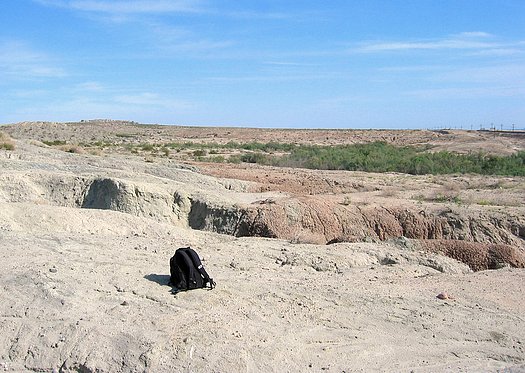
There probably isn't anyone that has not heard of the San Andreas fault. Just in case, it is the geographical fault that runs almost the full length of the state of California (and beyond) before sliding off into the Pacific Ocean north of San Francisco. It is the visible boundary between thePacific and North America tectonic plates. Earthquakes along it have caused billions of dollars worth of damage, but there was not a lot to damage in this part of California. That's the San Andreas fault in the picture below...not the big, scary-looking crack running across the picture, but the slightly red-colored ground running across the crack and off toward the hill on the left.
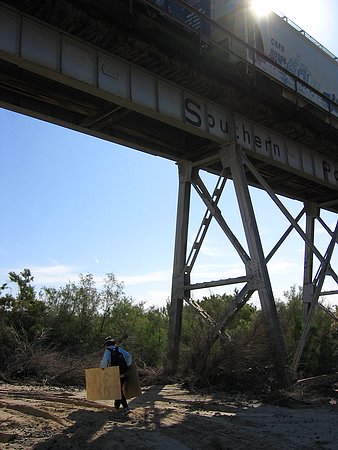
We had to hike a bit to get to a couple of our stations since the Taurus was not a 4-wheel drive vehicle.
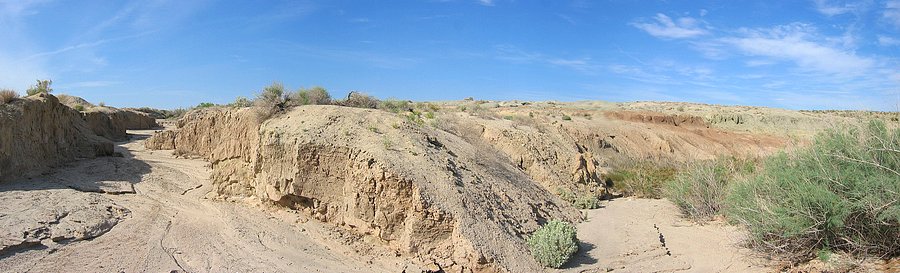
The landscape looked nice and smooth from the highway. The red area on the right side of the picture above is the fault.
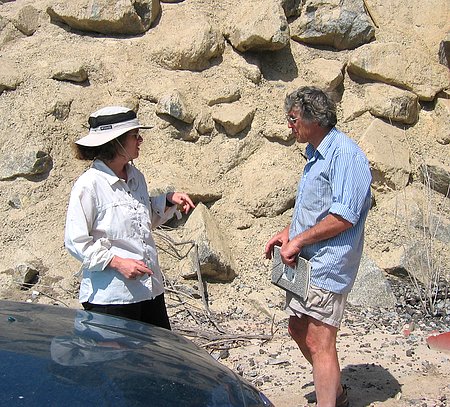
Wandering aimlessly in the desert we found Roger Bilham of the University of Colorado. He had several different sensors in the area that he was servicing and starting up in preparation for The Big One.
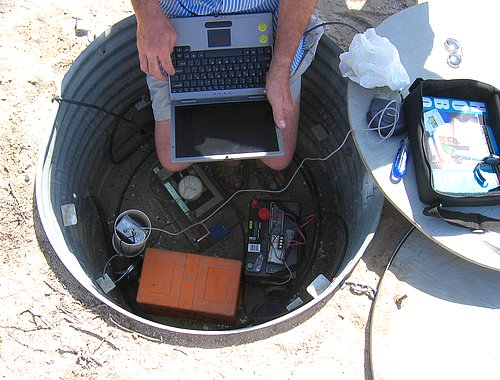
This station of Roger's was a small strain meter that spanned the fault. It was not a fancy laser type, but was simply a piece of wire that was stretched from this side of the fault to the other side about 50 meters away. A sensor connected to the wire simply measured how tightly the wire was being pulled. Roger's homemade recording unit fit into a short piece of plastic pipe (lower left-hand corner of the vault), ran on a few flashlight batteries, and could record for up to a year before needing to have its data downloaded. That is what Roger is doing in the picture above.
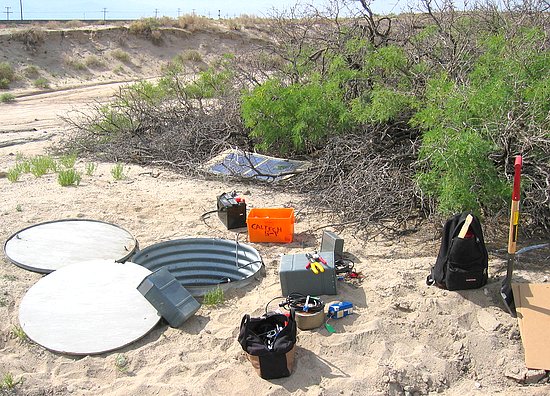
Our goal: Take Roger's nice, clean vault and stuff as much equipment, batteries, sensors, and wiring into it as we could.
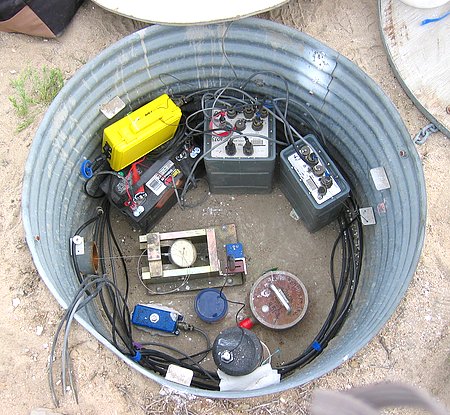
Above is the result of about 3 hours of work. At the 12 o'clock position is the Reftek digitizer. At 2 o'clock is the hard drive. At about the 5 o'clock position is an L22 1Hz sensor. The recording unit for the strain meter is the black, round object at the 6 o'clock position. The round blue item is a tin of grease that was used for waterproofing some holes. The blue rectangle is a 1g accelerometer. The object near the center of the vault was the anchor point for the strain meter. You can see the wire exiting through the tube on the left side of the vault. The yellow box is our power box that controls the charging of the battery that it is sitting on the top of by power from the solar panel. In a mild earthquake, miles from the epicenter, dishes in a cabinet can be thrown to the floor. This vault was a matter of yards from the fault itself. We used bailing wire to seat belt the equipment in place to prevent it from jumping around during an earthquake and landing on top of the strain meter. We had two sensors at each station. The L22 is a fairly sensitive sensor which will become overwhelmed in the event of a close earthquake. At that point the accelerometer will continue to record the event until its plaster lefts go and it begins flying around the vault like a plate thrown from a shelf.
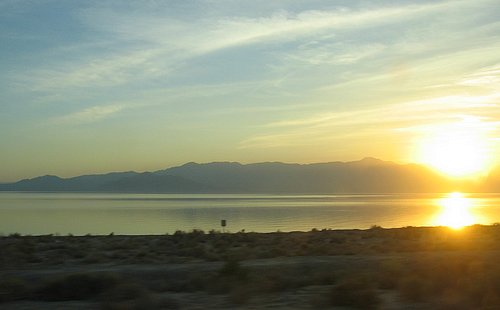
The end of a hot day.
2018-03-05