


The second order of business, after meeting with the Italian collaborators in Roma that worked for the Italian government agency Istituto Nazionale di Geofisica e Vulcanologia (INGV) on the day that I arrived, was to take a trip from Roma to our field headquarters in Grottaminarda, Avellino, Campánia on the second day. The trip took about three hours. INGV, as the title indicates, handles the studying and monitoring of Italy's volcanoes and earthquakes.

Benzene (gasoline) prices were -- from a U.S. standpoint -- shocking. Roughly US$4.00 a gallon. I suspect that there would be a mutiny if they ever got that high in America.
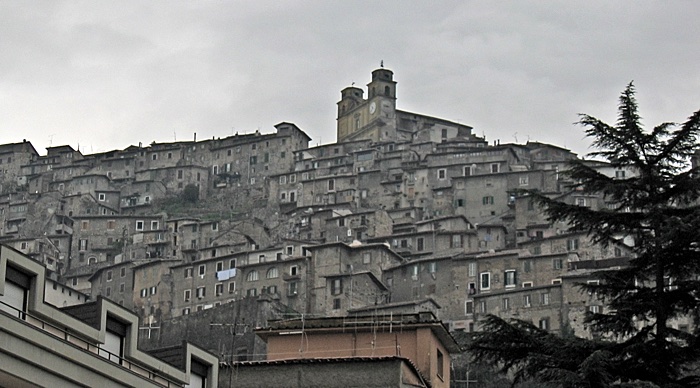
Above is the church and houses of the community of Artena just a few kilometers from Lanuvio. A lot of buildings leading up the sides of a hill with a church and/or castle on top was typical throughout the regions that we traveled.
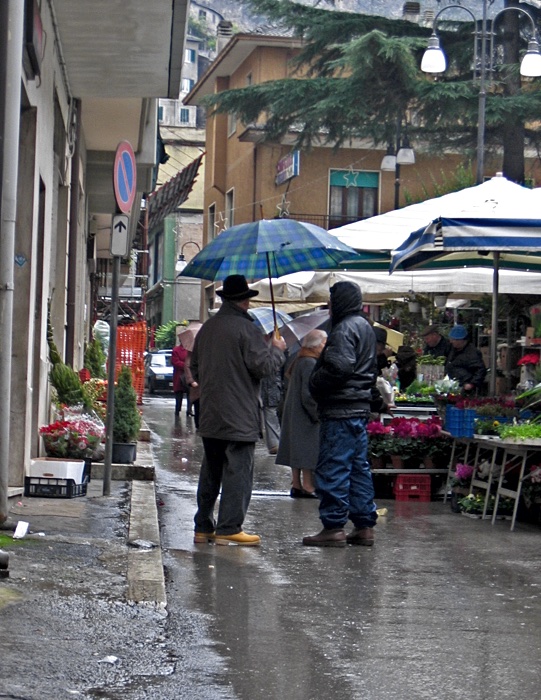
The winter months are the cold and rainy season in Italy, but it never seemed to keep anyone from getting out and about. While Italy is a modern country there were still a lot of homes and businesses in the cities that were heated with small wood stoves and fireplaces. Small trucks hauling firewood up and down the narrow streets was a fairly common, and quaint, sight.
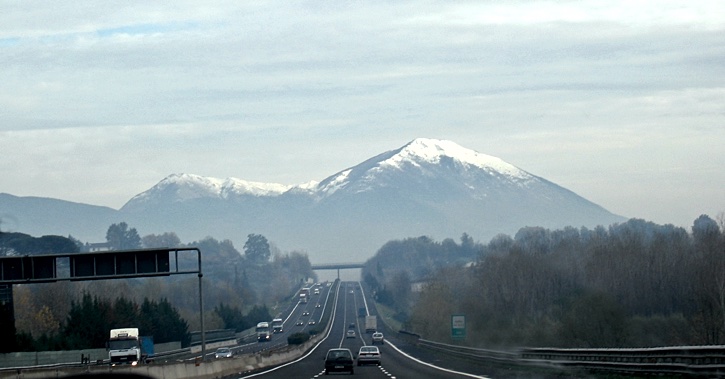
As you got further away from Roma, and the coast, the terrain took a turn for the vertical. From Roma the autostrade went inland and then paralleled the western slopes of the Apennine Mountains running in a southerly direction until reaching Nápoli (Naples). On the left in the picture above is Mt. Obachelle at 1466 meters, and on the right Mt. Cáiro at 1669 meters. Yes, that is snow, and yes, it was an indication of things to come throughout most of the six weeks that I was there.
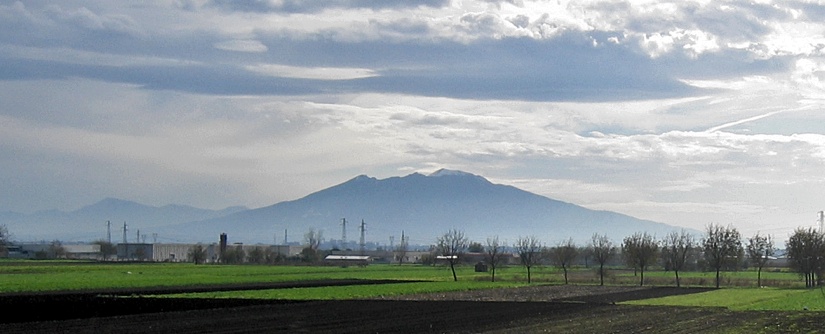
As we drove past Nápoli Mt. Vesúvio (Vesuvius), of the last days of Pompeii fame, could be seen in the distance in the picture above. Once we reached Nápoli we then turned east towards the interior of Italy.
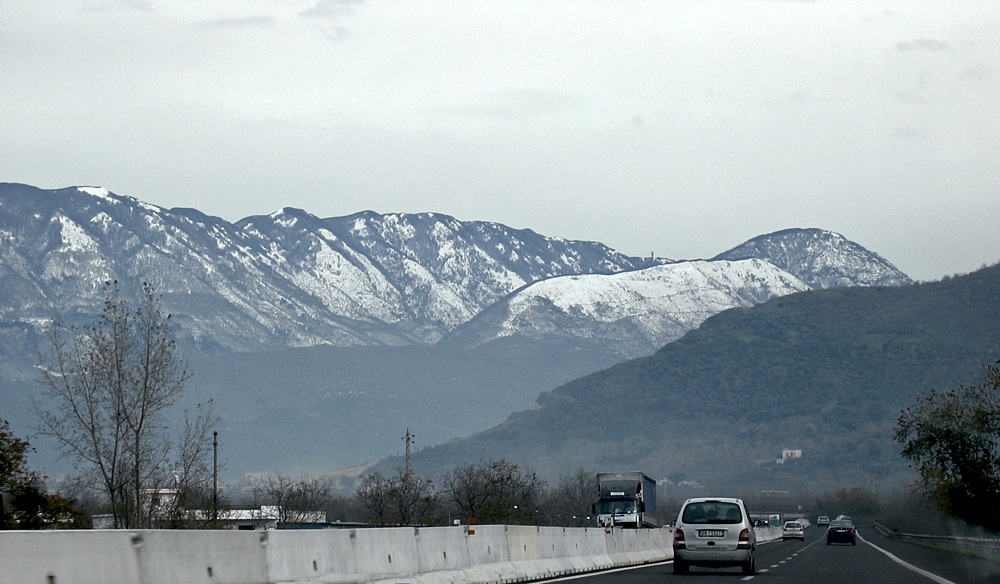
Above are the mountains of the Parco Regionale del Partenio which we had to go through shortly after leaving the Nápoli area.
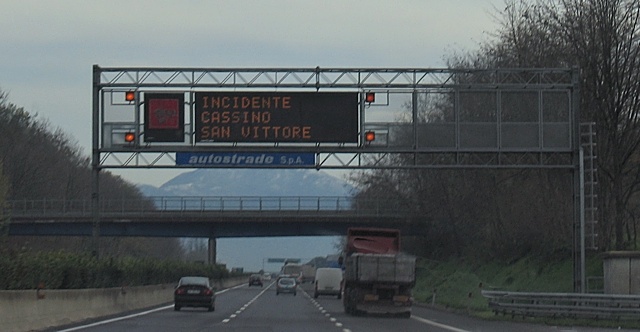
A fancy system of roads in Italy called the autostrade are basically equivalent to the Interstate Highway System in the US -- two lanes going each direction with a median between the two sets of lanes. The newer ones are toll roads. The electronic signs on the autostrade roadways warn of accidents and road conditions ahead. Italy has, and is building, quite a network of highways. While they will get you from point A to point B much more quickly than you could by taking the local roads, the exits off of the autostrade-like roads are few and far between. A16, which runs from Nápoli on the west coast almost to Bari on the east coast -- about 200 kilometers -- averages an exit only about every 30 kilometers. Traveling 30 kilometers where I live would involve a matter of minutes. In some parts of Italy -- many of which we worked in -- that distance could take a couple of hours, especially if the weather was bad without the autostada system. Once we got off of one of these main highways getting from point A to point B was rarely a straight line unless we were on the plains of Púglia.
2018-03-05