


John and Shaun took off the next day and left Matt and me on Ta'u to finish installing everything. Shaun had to get back to Apia, Samoa for some meetings and John went with him to get things started in Samoa.
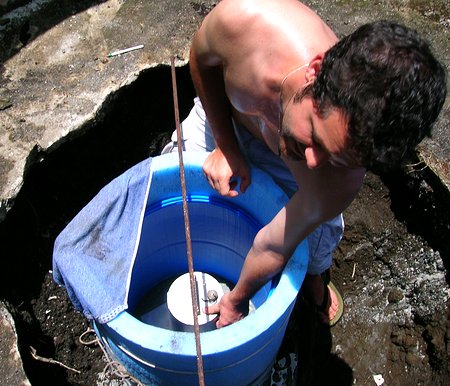
We used a simple Brunton compass to align the sensor to magnetic north. Once the sensor was in place we started backfilling the hole around the barrel. It is easier to get the sensor positioned just right when you are able to stand next to the sensor vault and the sensor, instead of having to lay on the ground next to everything and reach down into the barrel. The sensors for this experiment were three Guralp 3Ts, and one Nanometrics Trillium 40. That's one of the Guralp sensors in the picture below. They are pretty sensitive to ground motion and like to measure seismic waves that "vibrate" at one complete shake every 2 minutes.
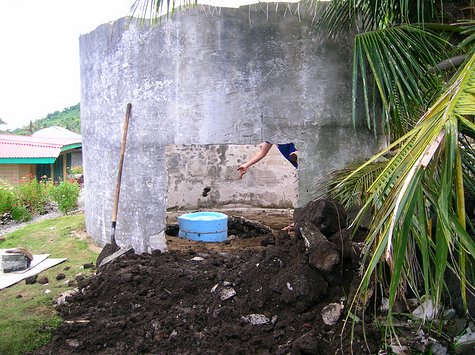
We put most of the dirt and rocks back, but even after that we came up a bit short of material. We couldn't use the larger rocks that had come out of the hole since they wouldn't be inclined to pack back in as well as looser material would, and that would affect the ubiquitous coupling.
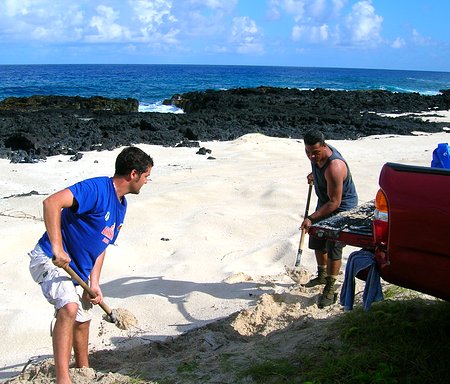
Junior, who lived across the street, helped us out by driving us in his family's pickup down to the beach to get a load of sand. I never did get time to go back down to the beach, but it was pretty nice.
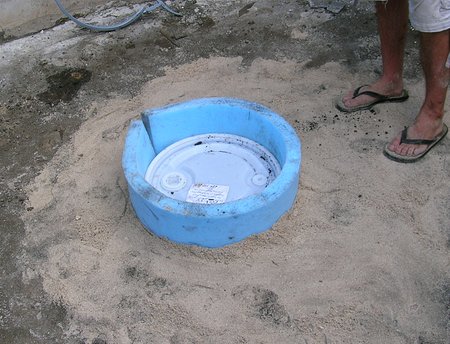
Backfilled. The sand seemed like a good idea at the time, but I should have
remembered from years gone by that it get's into everything.

The next step was to collect all of the pieces that were in the house and start moving them out to the cistern.
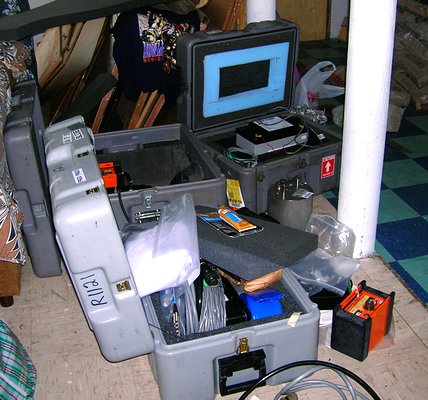
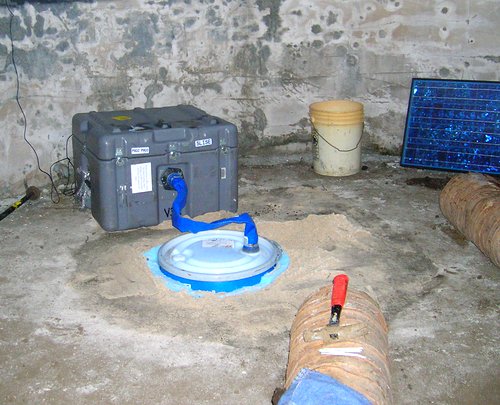
The digitizer that took the signal from the sensor and turned it into 1's and 0's, the disk drive where the data would be recorded to, the battery, and the battery/solar panel charge controller would reside in the big grey box which we called the station box. A cable to connect the digitizer to the sensor in the sensor vault (the barrel) had to run from the station box to the vault. In this system it was threaded through a two inch diameter tube that was secured to plumbing fittings on the front of the station box and the top of the vault cover with hose clamps.
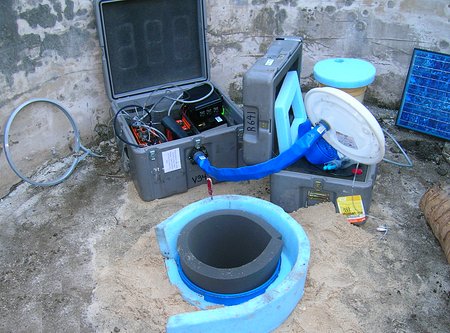
Below was as far as we got on this day, which was actually pretty far. Other than the box having been used on an experiment in Antarctica everything about this setup was experimental, so it took a little longer to figure out the best way to put everything together. We got the station, such as it was, up and running on the just the battery to collect a little data overnight.
2014-07-23