


The weather in Antarctica is nothing to sneeze at, unless, of course, you've caught a cold from it. It can go from clear blue skies to a 'blinding white hell' in a rather short amount of time. Depending on where you are and how prepared you are when the snow hits the fan can mean the difference between being inconvenienced or being dead.
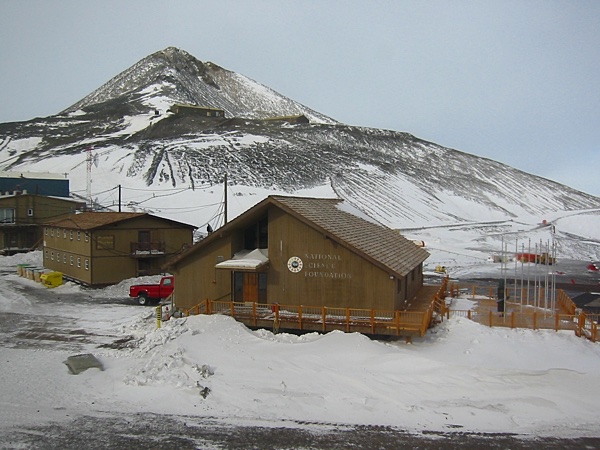
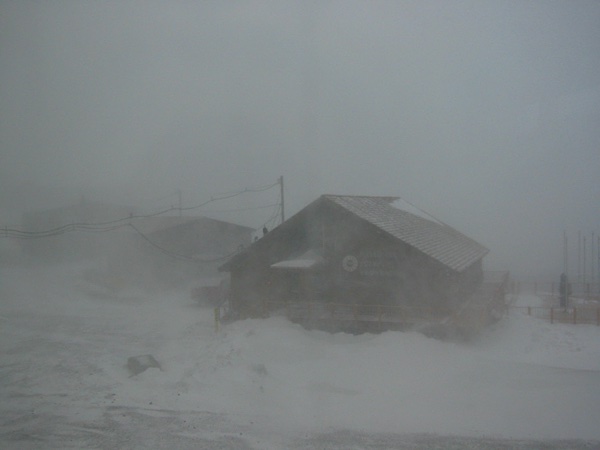
Above is the NSF chalet in McMurdo on a good day, and a not so good day, which
was actually the same day. And this wasn't even a REAL storm. It was just
a little snow shower.
The condition of the weather is rated at all of the U.S. stations and camps."
Condition 3" means that the weather is good and that you should take
all of the normal precautions. "Condition 2" would be weather like
in the picture above. No travel outside of the camp is allowed if you are
alone, you must check in and out with the fire station and/or MacOps (the
station's communications control center), etc. "Condition 1" means
that everyone is restricted to where ever they are, and only emergency services
personnel are allowed outside the buildings to handle emergencies.
In general, you don't go anywhere in Antarctica without a fair chunk of your
Extreme Cold Weather (ECW) gear either with you or on you, and without someone
knowing where you are going and when you will be back. In most cases you don't
go alone, either. In the field you always take radios, your ECW gear, and
what is called a survival bag no matter what the weather is like. The survival
bag contains food, a stove, tents, and sleeping bags to support a given number
of people for a given number of days. ECW gear and survival bags were carried
with us on all of our boondoggles, and also when we were working out in the
field even when we were only going to be working a couple of kilometers from
camp.
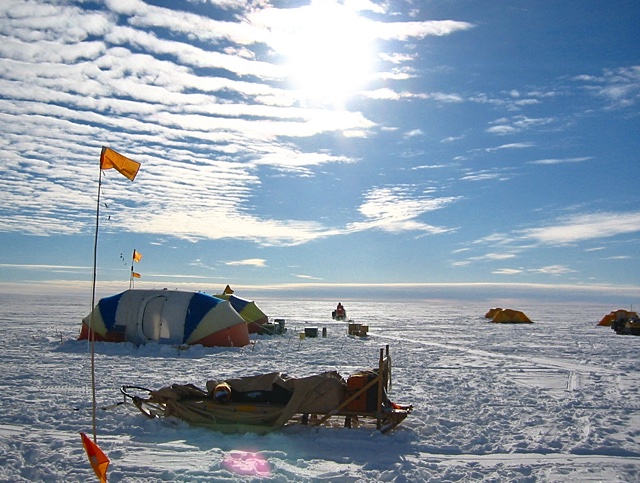
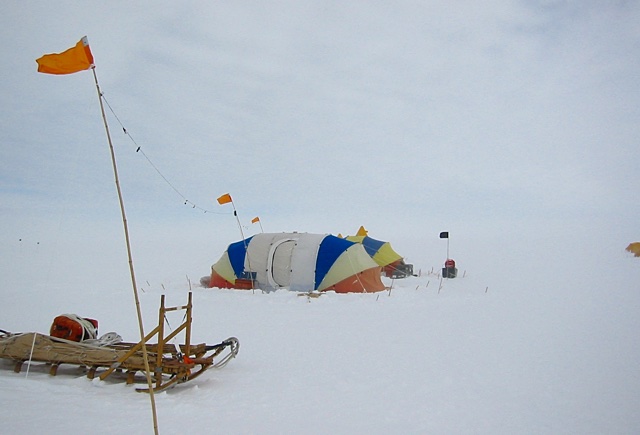
Above are pictures of our camp at Ice Stream C (line CT1) on the day we arrived,
and on a day when we got a day off to do things like work on this web page.
The bottom picture above shows what is known as a low-contrast condition.
There's nothing really blocking your view of anything, maybe just a little
blowing snow, but if you compare the the two pictures you'll notice that you
can't see any detail on the ground in the bottom picture. Everything on the
ground is the same shade of white. There IS only white on the ground, so the
only way for it to show any detail is for there to be shadows of some sort
like there are in the upper picture. There were the same number of bumps and
dips in the snow on the day the bottom picture was taken as there were the
day the upper one was taken. The lighting is such that you just can't see
them. This happens when the cloud cover is thick enough to make the sunshine
appear to be coming from every direction at once. The effect is very real.
I walked straight into a one meter high snow drift during one of these kinds
of days. I absolutely could not see it right in front of me, and I even knew
that it was there. Of course I could see it just fine after I fell and my
nose was pressed up against it. Things like polarized sunglasses don't help.
We did some traveling on days like this. It wasn't a lot of fun, but it was
pretty interesting until it would start snowing hard enough to where you couldn't
see any more than a few tens of meters in front of you. At that point there
wasn't much to do but go slow, stare at the little arrow on your GPS receiver
telling you which direction to go, and hope you didn't bump into or fall into
anything too big.
2018-03-05