


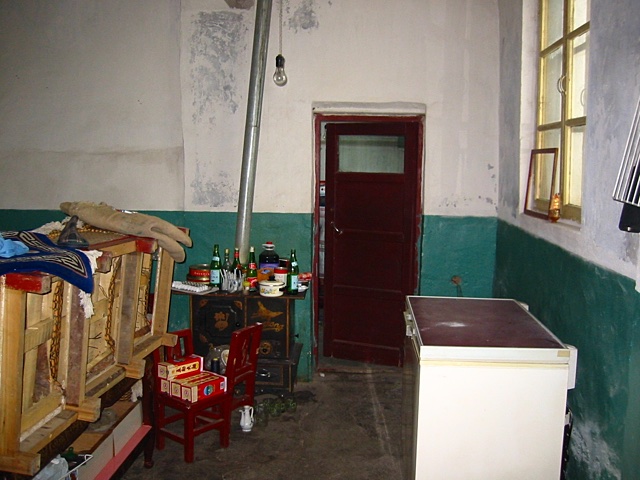
What we basically did was roam the countryside looking for areas with fairly reliable electric power, somewhere off the beaten path (to keep the sensors from being flooded by noise from people and machines), and that satisfied the scientific goals of the experiment. Once we found a suitable area we usually just asked around until we found a private dwelling with an unused storage room of some kind with a cement floor. It sounds easy, but sometimes it took up to six hours to find the right place.
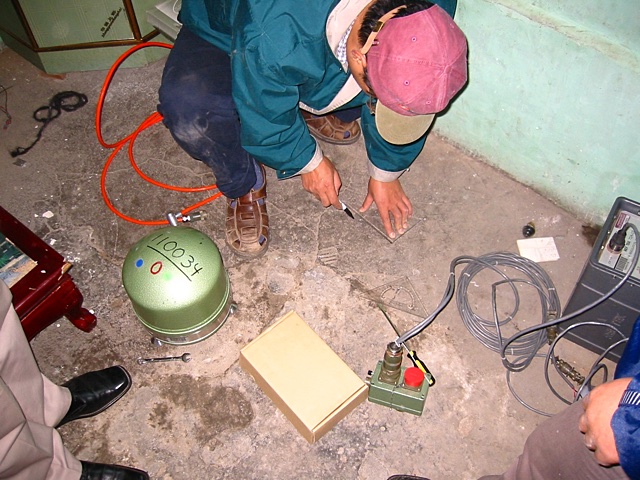
Once a location was found in the room the sensor was placed where it would sit until the equipment was removed. Above Wenjie is drawing lines on the floor to align the sensor as close as possible to north-south and east-west. The sensor measures movement in the north-south direction, east-west direction, and in the up-down direction. Aligning the sensor was required so that the direction of arriving seismic waves could be accurately determined.
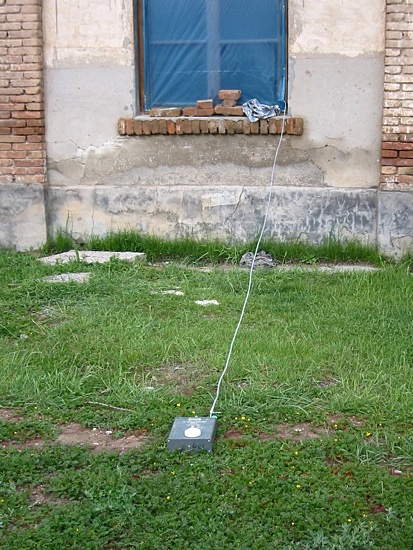
Placing the clock next to a building obscures the satellite signals and can
delay getting a first lock (at least within the span of normal field personnel
attention spans
 ). Sometimes the clock had to be moved out away from the buildings to get
a clear view of the sky. Once the lock was obtained the clock was placed back
next to the building (resting on a window sill in the picture above), since
subsequent locks could be made with fewer satellites in view.
). Sometimes the clock had to be moved out away from the buildings to get
a clear view of the sky. Once the lock was obtained the clock was placed back
next to the building (resting on a window sill in the picture above), since
subsequent locks could be made with fewer satellites in view.
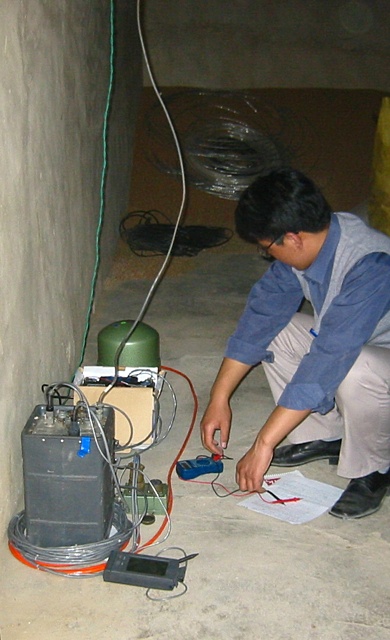
After getting everything installed and powered up much of the remaining time was spent waiting for the sensor to stabilize a bit, and for the clock to get a satellite lock and begin producing accurate timing signals. The STS2 sensors are quite sensitive. Even the heat from your body when you approached them, much less vibrations from people walking around the area, could be detected by the sensor. Once the sensor was leveled, powered up, and the moving sensor elements unlocked a centering procedure was performed. This was done to make sure that the moving parts of the sensor were free and clear and that the sensor was accurately leveled. It can sometimes take up to several days before the sensor fully settles down.
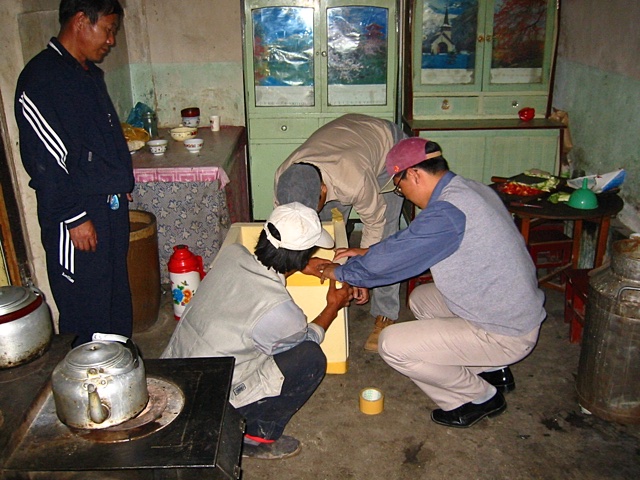
Above we are constructing a foam rubber box. Since the sensors were very sensitive to temperature changes these were made to cover the sensors to help minimize the effects.
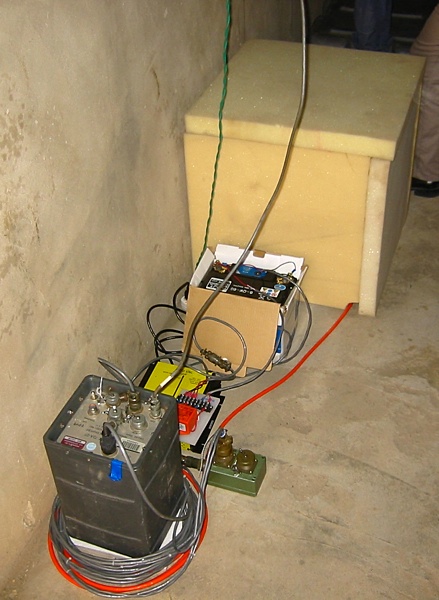
A finished installation. One battery was installed at each station to keep the equipment running during power outages. The yellow box was the battery charger/power supply.
2018-03-05