


On my first PASSCAL experiment, at Hill Air Force Base, we drove past the Hill Aerospace Museum every day. It only took me five years to drop in and see the place.
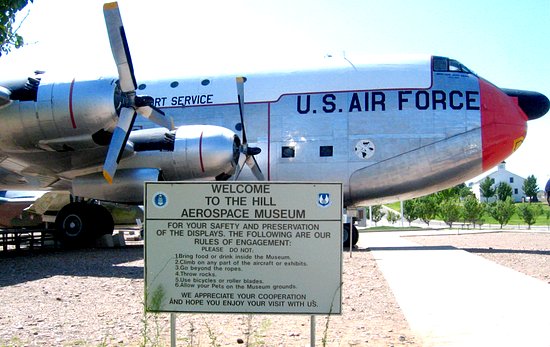
Above is the Douglas C-124C "Globemaster". The first of these flew in November of 1949 and remained in service transporting troops, patients, tanks, bulldozers and trucks all over the place until mid-1974. The bottom portion of the nose dropped open and formed a ramp.
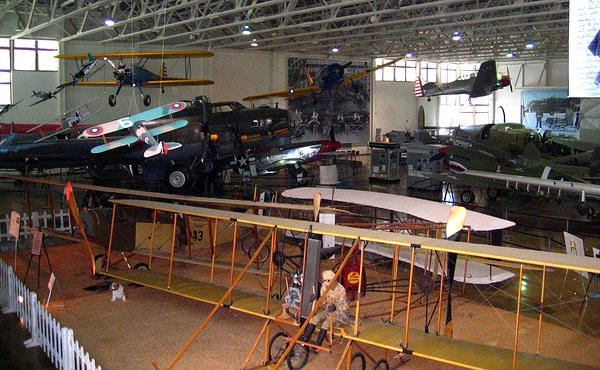
The museum was made up of a display area, a small auditorium, a gift shop, then one large building, above, and another large hanger that appeared to be in the process of at least doubling in size.
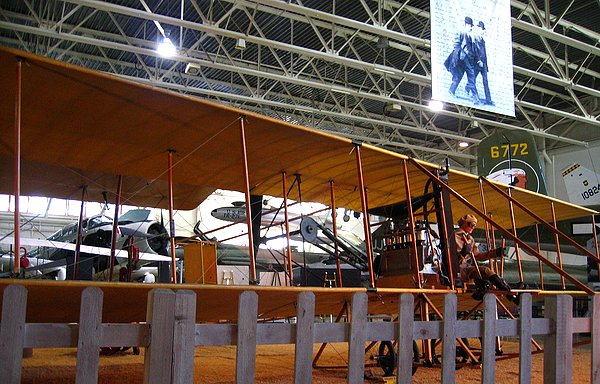
Above is the 1911 Burgess-Wright model B "Flyer", or it may be a model F. It depends on which source you read. It was the result of a collaboration between the Wright brothers and a yacht designer and builder Starling Burgess. The model F was the first airplane licensed for production in the United States. Over 100 model F's were built for commercial and, of course, military use.
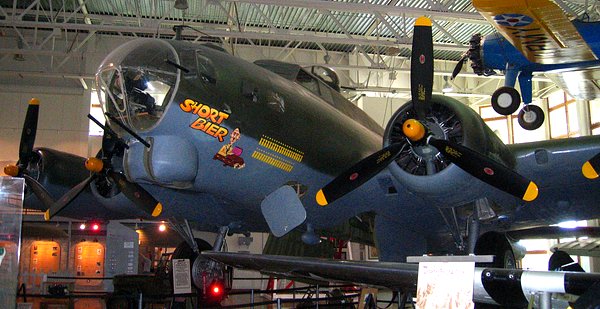
Above is the Boeing B-17G "Flying Fortress". Development of the B-17's began in 1934, the first one flew in 1935, and production began in 1936. That kind of schedule would never fly these days. There just wouldn't be enough time for delays and cost overruns. By the time they stopped building the four-engine bombers in 1945 about 12,270 of them had been produced.
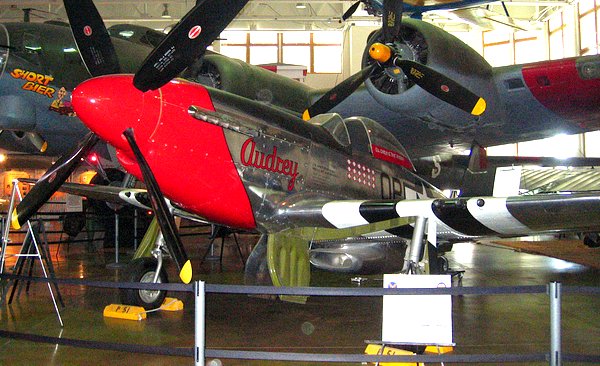
P-51D "Mustang" was probably the finest all around single-engine fighter produced during World War II. It was originally developed for the British RAF after North American Aviation rejected the original aircraft the RAF wanted. The first Mustang was designed and built in less than 120 days. Designed in 1940 the last of the Mustangs were retired from service in the 1970's.
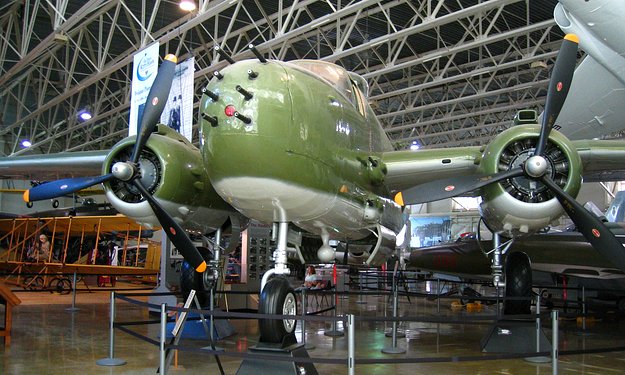
Above is the North American Aviation B-25J "Mitchell" that was named for General Billy Mitchell who advocated greater airpower in the armed forces even before it became necessary. The most famous of the exploits of this airplane was General (a Lieutenant Colonel at the time) Jimmy Doolittle's raid on Tokyo in April 1942. It was to be the first air raid by the U.S. to strike the Japanese home islands of World War II. Sixteen of the US Army Air Corps planes took off from the heaving deck of the aircraft carrier USS Hornet (CV-8) even though they were not designed for such a take-off. Everything that could be stripped from the planes was to get their weight down. The trip was one way. After flying over Tokyo and dropping their bombs the planes continued on to mainland China (an ally of the U.S. at the time). Most of them successfully crash landed in China. One landed in Russia. The normal version of the plane had 18 .50 caliber machine guns and could haul 3200 pounds of bombs or one 2000 pound torpedo.
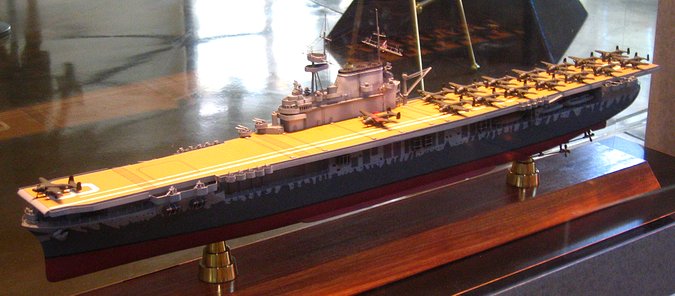
Above is a model of the USS Hornet (CV-8) showing how the planes were strapped to the deck of the Hornet for their trans-Pacific trip.
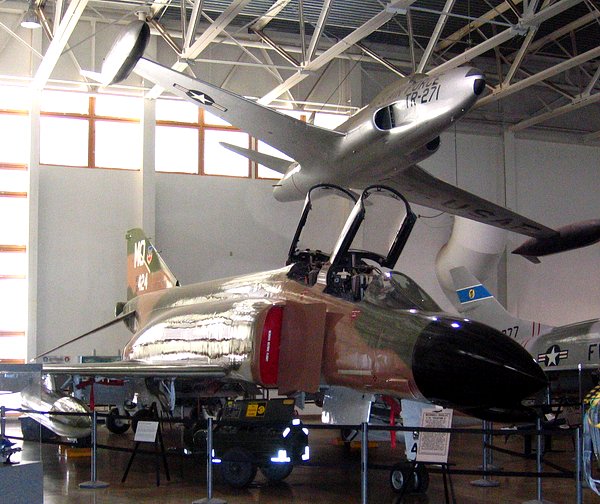
Hanging above is the Lockheed T-33 Shooting Star which first flew in 1948. It was developed from the Lockheed P-80/F-80. Almost 6000 of the jets were built between 1948 and 1959. Both the Navy and the Air Force had models of this plane which made it the first trainer used for both carrier and land-based operations.
On the floor is the McDonnell Douglas F-4C "Phantom II". Sigh. What can't be said about the F-4? The F-4 line originally went into service for the US Navy in 1958. They were later approved for use in the Air Force in 1962. By the time they stopped being built in 1979 over 5000 of them had been produced. The plane set all kinds of speed and altitude records in its day. All of the F-4 models, the F-4 through the F-4F were fast, agile and dependable. A lot of them are still in use by air forces around the world.
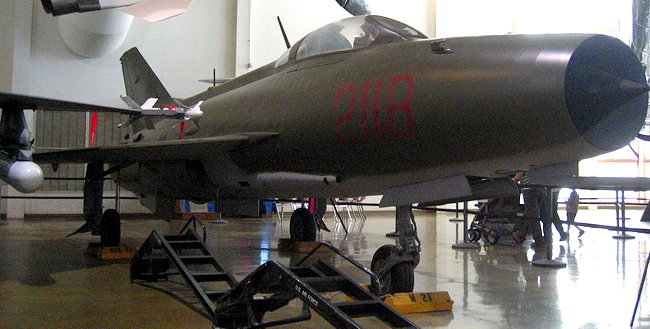
The prototype of the Soviet Mikoyan-Gurevich MiG-21 "Fishbed", above, appeared in 1955. The MiG-21 went on to become the most widely used modern jet aircraft in the world with an estimate of 8,000 being produced both by the Soviet Union and other countries.
2018-02-12