


Above is the Northrop T-38A "Talon" was the Air Force's first supersonic jet trainer. They first flew in 1959 and remained in production until 1972. A total of 1189 of them were produced. I got to sit in one of these in the early 1970's. If only I'd known what to do at the time. The T-38's are used as pilot trainers, and for flying astronauts around when they are not in space. At least that's what I've seen on TV.
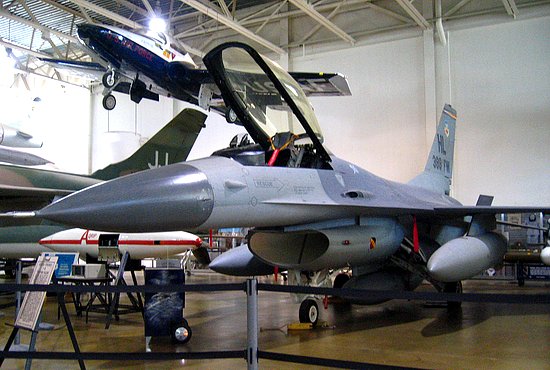
Hanging in the background of the picture above is the T-37B "Tweet" which first flew in 1955 and is still used as a pilot trainer. The planes were modified and upgraded starting in 1989 and about 400 of the original 1000 that were produced are still in use.
On the floor is the General Dynamics F-16 "Fighting Falcon" which first flew in 1974. It's development was the result of the Air Force's search for a lighter and more maneuverable fighter plane. One fighter wing of these aircraft is based at Hill AFB.

Above is, of course, the Lockheed SR-71 "Blackbird", which in this panoramic shot looks more like some kind of flying saucer. It's the plane that, of course, spy stuff is made of (after the U-2). The first SR-71 flight took place in December 1964. The fleet was retired from the USAF in January 1990. The cost of operating the planes was about $200,000 per hour and at the time the Air Force, like the Navy I'd guess, needed money for $2000 toilet seats and $700 hammers, so something had to go to cut costs.
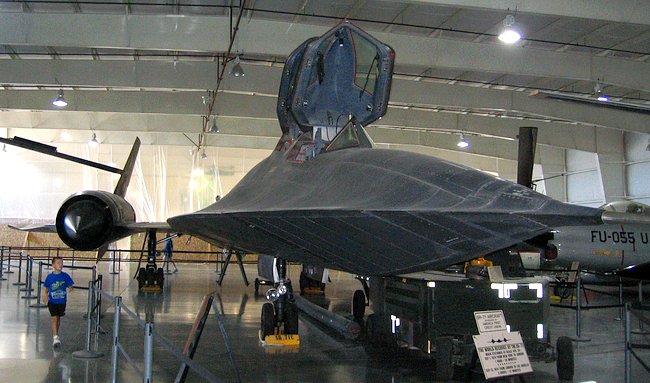
The SR-71's, of course, were the highest and fastest operational aircraft -- that we've been told about. Their speed record was 2193.167 mph, and their altitude record was 85,068.997 feet. I'm not sure how they got such precise values.
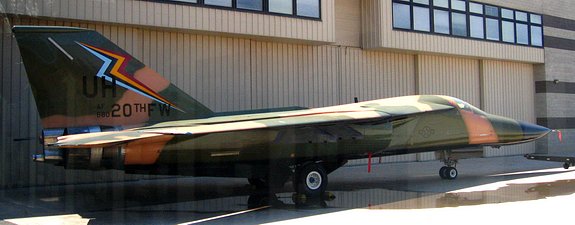
I don't Know what it did wrong, but this lonely F-111 appeared to be being punished with a "timeout" by sitting by itself out behind the museum.
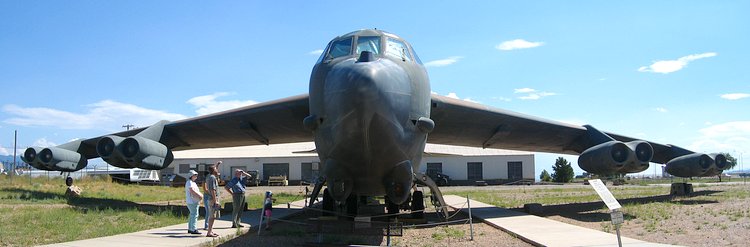
Above is the B-52G "Stratofortress". The first plane of the B-52 line made its first flight in April 1952. This G-model had a couple of machine guns, and, oh yeah, 66,000 pounds of bombs. Many of these planes were still in use in 2005.
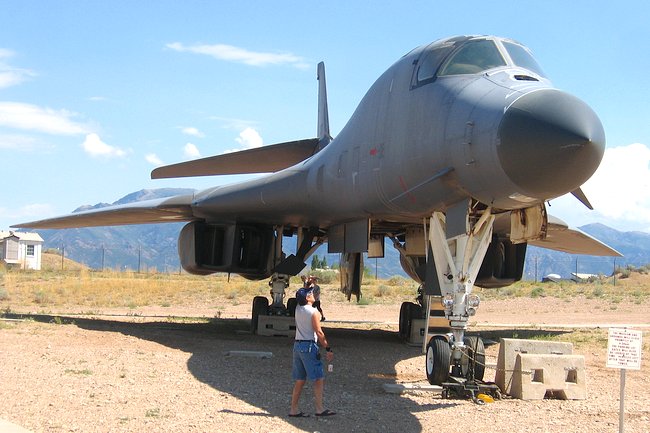
The Rockwell Boeing B-1 Lancer bomber, above, was supposed to be the replacement for the aging fleet of B-52s. The first flight of a B-1 took place in December 1974. Aside from the sticker shock it looked like a good idea at the time. The original version of the plane was cancelled before it went into production, but the B-1 was reworked and reappeared as the B-1B in 1981. The first production B-1B was delivered in June 1985. 94 of the planes were still in use in 2005.

You could store a large truck in there if it weren't full of bombs.
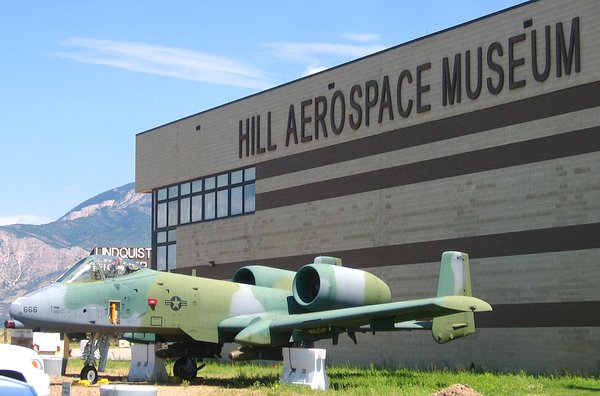
The Fairchild Republic A-10 Thunderbolt II"Warthog", above, started service in 1976 and was built for close air support. They were still in use in 2005. They were the first aircraft designed specifically for the close air support role. They can carry up to 16,000 pounds of mixed ordnance from 500 to 2000 pound guided and unguided bombs to Maverick and Sidewinder missiles. It's 30mm seven-barrel Gatling gun can fire 3900 rounds per minute. That would melt my Glock pistol.
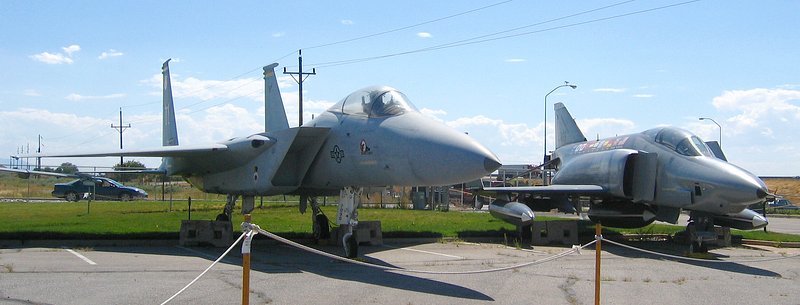
On the left in the picture above is the F-15 Eagle began its life in the mid 1960s as the first dedicated air superiority fighter to be procured since the F-86 Sabre (the Korean War!). McDonnell-Douglas was awarded the contract for the F-15 on December 23, 1969. The first F-15A flight was made on 27 July 1972. After an accident-free test and evaluation period, the first aircraft was delivered to the Air Force on November 14, 1974. Since the aerodynamic design of the plan is still on par with modern fighter aircraft design, and with the the proposed and ongoing electronics and structure upgrade programs the F-15 may well be around until the 2030's. The fighter to the right of the F-15 is an F-4E.
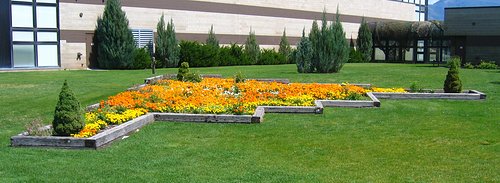
Cute. They didn't have a B-2 Stealth bomber at the museum, yet, but the flowers near the entrance were surrounded by the outline of one. I'll have to go back and see that when they do get one.
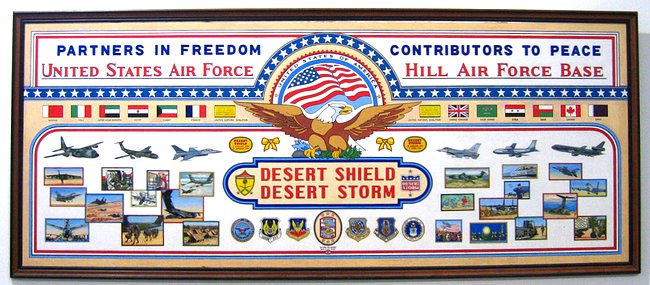
Good on 'em. Keep up the good work!
2018-01-27