

Our instrument center ended up in the underground parking garage of the town's convention center. The building was originally a casino, but it went bust at some point. I didn't notice it until now, but it didn't have a lot of windows, which, of course, makes sense since it was a casino (they don't want you to know what time it is when you're gambling).
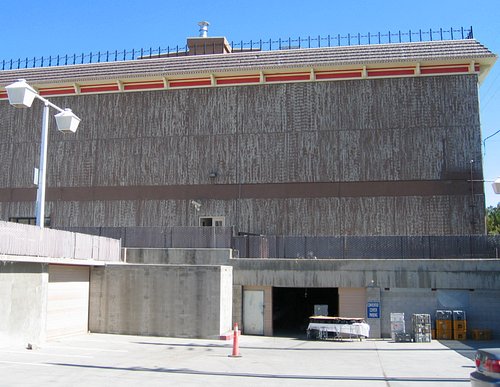
The folks at the convention center were going to put us in an unused portion of the 3rd floor of the building, but having so much equipment would have made that a bit more than inconvenient. There was an elevator...but still. They felt bad about sticking us in the basement, but we were happy to have the space and the easy access to the outside. On top of that the temperature was always cool even when it was warm outside. It did get a little chilly at night, but we survived.
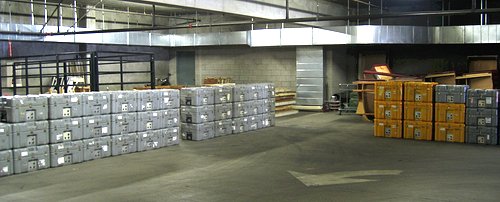
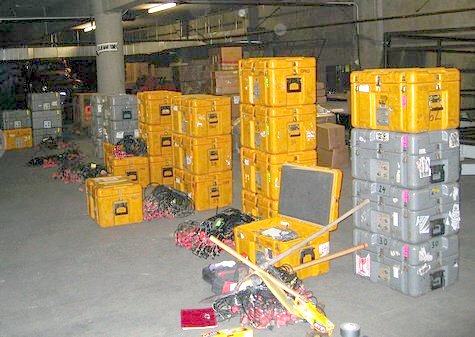
Below is newbie Lloyd Carothers of PASSCAL shuffling Texan transport cases around. In all there were four of us from PASSCAL there. Two old-timers and two new-timers.
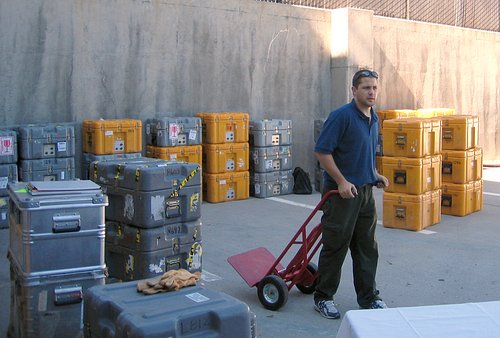
The name of the game for this experiment was production. We maintain 1000's of sensors and data recording units. When equipment returns to the instrument center in Socorro after a project it needs to be updated, tested, and made ready to go back into the field usually as soon as possible. Sometimes the equipment needs to be made ready to go even faster than that. Sitting on the table in the picture below is 15 of the model 130 recorders. In order to test the 100 units we shipped to make sure that they survived the shipping we needed to crank through them pretty quickly. In addition to testing they needed to be programmed with recording parameters for this experiment. To do this we brought some equipment and software that we normally use in back in the lab to check out the equipment.
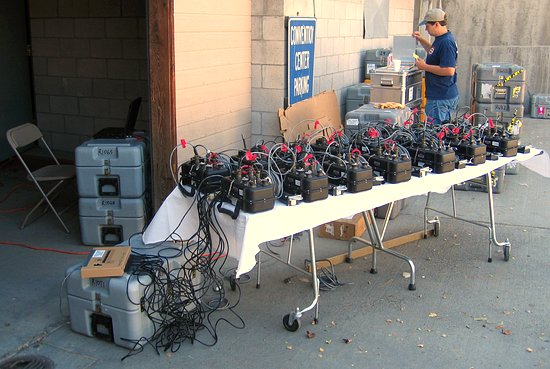
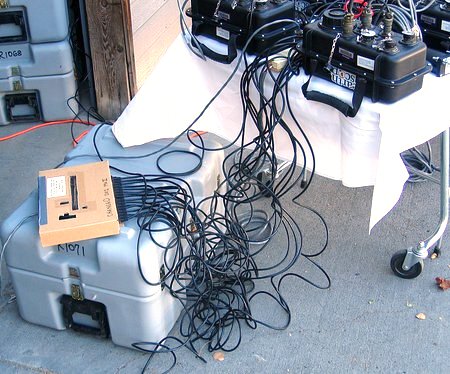
The program we wrote to control and test up to 15 recorders at a time communicated with the hardware we wanted to test and program through a serial interface board also built by us. Just so the people from Stanford wouldn't think we were a bunch of hicks we enclosed our circuit board in a custom designed box. We hoped that they wouldn't notice that it was cardboard. We advertised it as processed hardwood. I think they bought it.
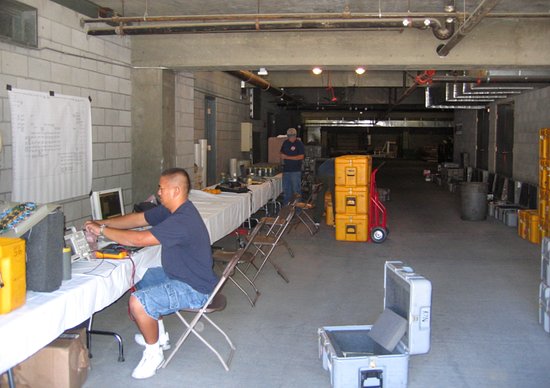
Near the entry to the parking garage we set up tables to work on and set up all of the computers that would be used to program, offload, and process the data from the Texan recorders. That's Mario Torrez, the other new guy, from PASSCAL at the table fixing some of the electronic equipment that was in the cases that held the Texans during the programming and offloading phases.
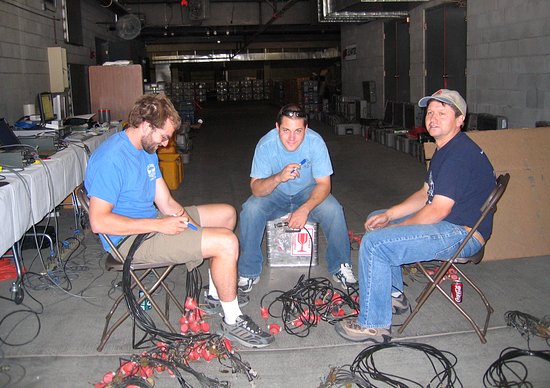
In addition to the usual Texan equipment from PASSCAL and the University of Texas at El Paso, there were also Texans from Poland and Denmark. It started getting a bit confusing until we sat down and marked everything with the name of their owner. On the left in the picture below is Derek when it wasn't his birthday, Lloyd, and Steve Azevedo. Steve was the other PASSCAL old-timer.
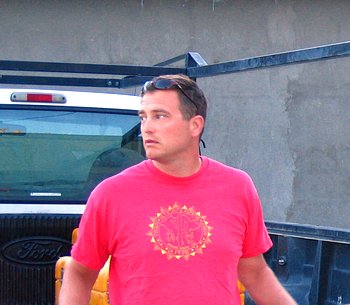
Below is the infamous Charlie "Crash" Wilson. He was another PI/student on the project from Stanford. I don't think Charlie was an unlucky guy or dangerous or anything, but he did manage to go through about a half a dozen tires and the engine of one whole Suburban during the project. I think he managed to get stuck a couple of times too, and as a result had to spend the night in a couple of off-the-beaten-path places.
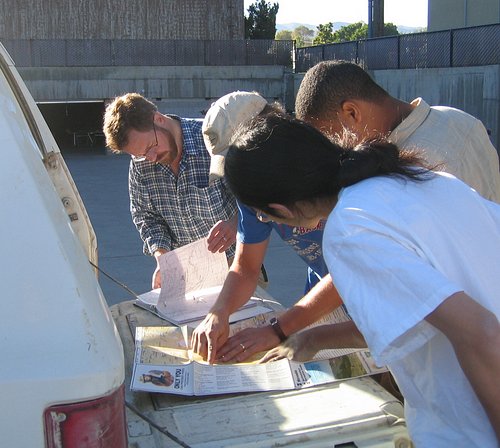
Reviewing the game plan below with some of the 1000's of deployers (it seemed like that, anyway) was Simon Kemplerer from Stanford. SOMEHOW he managed to keep this whole menagerie running despite every mishap and change of plan that could have ever been conceived. He came armed with poster-sized spreadsheets of where everyone and everything should be everyday of the experiment. He also had a Sharpie marker.
2018-02-08