


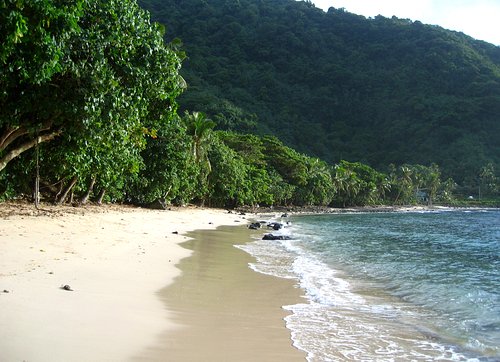
A couple bays east of Pago Pago was the village, beach and bay of Alega. Most of the land in the area was owned by one family and, not by accident, it was one of the least populated bays on the island. The owners liked it that way. Tucked away at one end of the bay was the world famous (i.e people from all over the world have been there) Tisa's Barefoot Bar. It was owned by Tisa who grew up in the village.
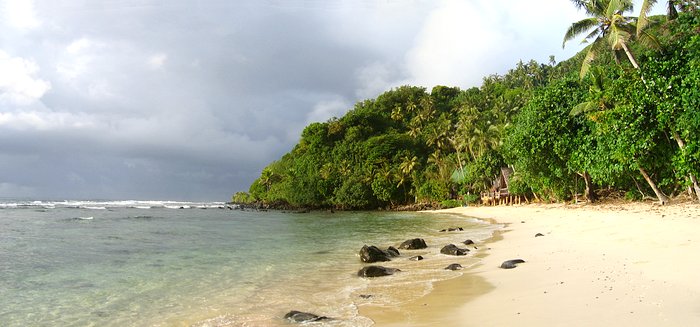
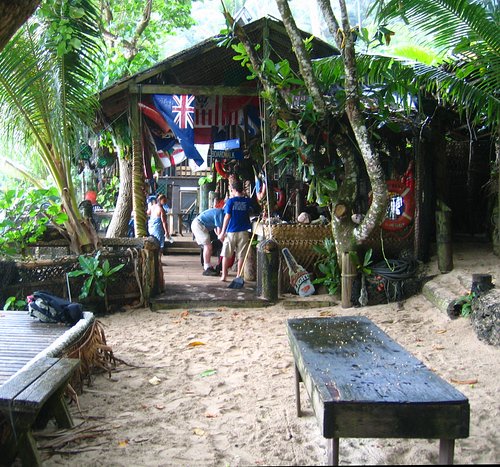
Nice beach. Nice view. The buildings in the picture below were two fales where you could stay if you'd had a little too much to drink, or were installing seismic stations and had a little too much to drink. There was one bed in the small building, and two in the larger A-frame one.
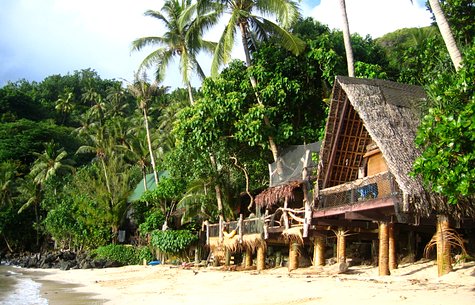
Ahhh. A lot of peace and quite, and the owners liked that too. While there were parties and crowds from time to time at the bar they were always kept under control and usually wrapped up pretty early. The bar was "you're staying all the way out there?" in island terms, so people from town (Pago) usually left early.
We arrived in the Samoan islands at just the right time of the year. Somewhere around the seventh night after the first full moon after the autumnal equinox any of a dozen species of worms that live amongst the coral reefs of the Samoan Islands (and other South Pacific islands as well) come out of hiding and rise to the surface of the ocean. They are collectively known as palolo. What 19th century biologists noticed was that they weren't really worms ay all, but just the back halves. The muscular contractions of the headless worms carry them to the surface where after about an hour they split to release their egg packets and sperm. The two mix, and, well, you know the rest.
During the few hours all of this is all going on the Samoan coastlines become crowded with Samoans armed with homemade nets, lights, and buckets. The next day automatically turns into a feast day. Fried, baked, sautéed, or baked into a loaf the palolo are. Below is a picture of the delicacy. They had a fair harvest just before we arrived and we were able to have some of the palolo cooked with onions and coconut milk one dinner at Tisa's. It was pretty good stuff.
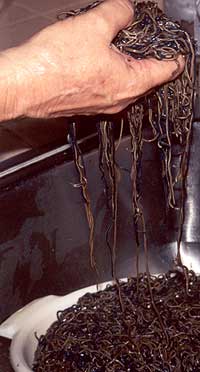
From a Smithsonian website
The bar proper. In the overhead hung flags from a lot of places around the world donated by visitors.
On Wednesday evenings varying numbers of people made reservations and came out to Tisa's for dinner cooked in an umu. Below is an umu. Looks delicious. Doesn't it? The umu was really just the oven.
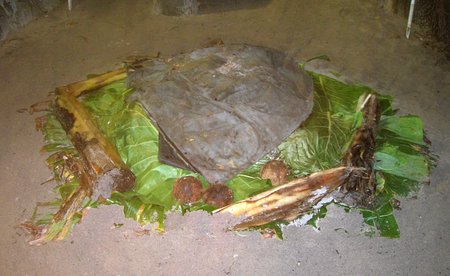
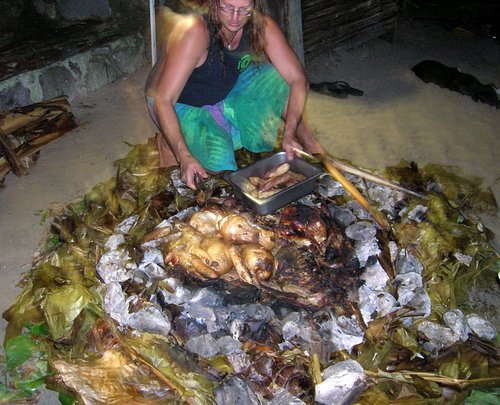
A few dozen rocks are heated with fire in a shallow depression in the sand. After the fire goes out the hot rocks are covered with a layer of leaves, a layer of food and spices, and then a lot more leaves. Below is the umu with the top layer of leaves removed. Chicken, pig, lamb, taro, cooking bananas, squash, fruits, you name it and it was in there and cooked -- closer to steamed -- to perfection in just a few hours. That's Candyman nabbing the food. He was an ex-road construction guy from New Zealand and was the man of the bar.
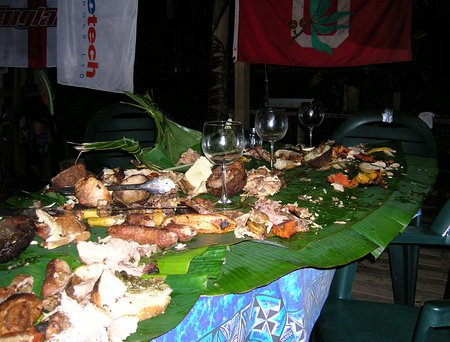
To keep the feast authentic and messy there were no eating utensils, except for a large knife...and wine glasses.
Below is John, Stanley Malae, me and Matt. Stanley, who Matt met on his previous trips, was a pilot for Inter Island Airlines. We used the airline quite a bit during our stay to hop between the islands and the two countries. Everyone that worked for the airline, as well as Stanley and his family, were very nice.
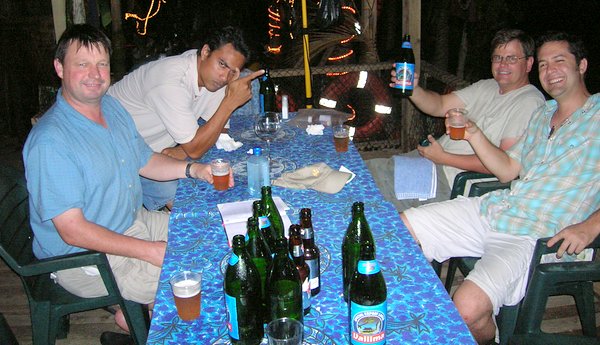
Taking the picture above was number five in our band of merry drunkards, Shaun Williams from Apia in the other (independent) Samoa. Shaun worked for the geophysics section of the Ministry of Natural Resources, Environment and Meteorology of the Samoan government. Matt met Shaun while doing research in Samoa. We didn't really drink a bunch on this trip, but with the heat and humidity we were always drinking SOMETHING.
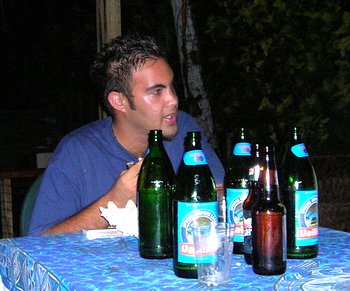
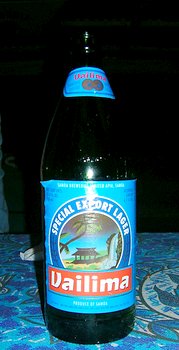
When you got thirsty in the Samoan islands the only thing sensible to do was to have a Vailima Beer. Apparently. It was brewed in Samoa and was probably more popular than Coke. It was pretty good beer, and fortunately, in some places, all you could get was the convenient one liter size. As an added benefit there was a Special Export Lager version that was available in American Samoa that only had a 6.4% alcohol content.
2014-07-23