

And I thought only Americans were crazy enough to do big things like this.
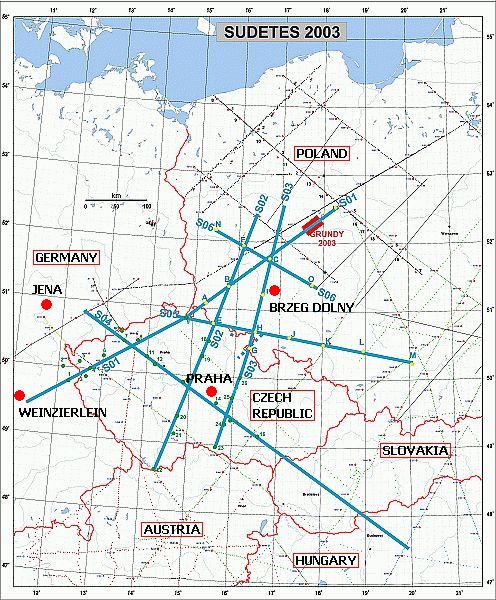
This project covered a large portion of Central Europe including the countries
of the Czech Republic, Germany, Hungary, Poland, and Slovakia. The blue lines
represent the paths along which a total of 1000 Reftek RT-125 "Texan"seismic recording instruments were placed, and along which, for the most part,
about 50 explosions of about 1000 kilograms of explosives each were set off.
My job was to take care of the Western Front and handle the instruments --
all 85 of them -- for the portions of the lines S01 and S04 that extended
into Germany.
This experiment was the most recent one of a group of experiments that have
pretty much covered the central part of Europe. The other dots and lines
on the map above show where the other experiments have been carried out.
As is usually the case the goal of this and the other experiments was to find
out the structure of the Earth beneath the area.
My involvement with this project actually began a week or so before my arrival
in Europe when I was in El Paso, Texas to help with a quick, but substantial,
project there. The 800 or so "Texan" data recorders owned by the
University of Texas at El Paso (UTEP) and PASSCAL recorded data one night,
had their data offloaded the next day, and were packed up and shipped to Europe
a couple of days later. All of the equipment had to be counted and sorted
before shipping. To aid in everything making it through customs in the Czech
Republic (where all of the equipment went first), and then with the customs
departments of the individual countries, specific amounts of equipment, and
specific instruments (identified by serial number) were sorted and counted
for each country that was to participate in the SUDETES project. Guess who
got to help count and sort all of it in the hallways of the geosciences building
at UTEP?
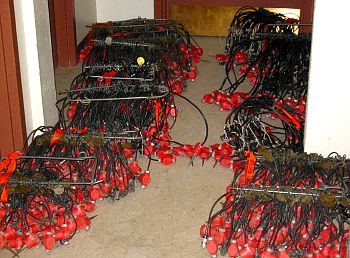
This experiment used geophones that stuck into the ground and measured the
vibrations from the explosions. Below are a few hundred of them counted and
ready to the put into shipping cases. A geophone is basically just a moving
magnet inside a coil of wire that when wiggled produces a voltage. These electrical
signals are digitized and recorded by the Texans. The geophones were designed
to detect vibrations at a frequency of about 4 Hertz.
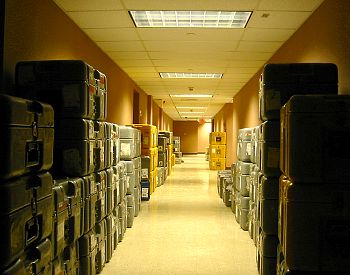
Below are some of the shipping boxes for this experiment in the hallway at UTEP. In all there was about 2000 kilograms of equipment in 97 shipping cases.
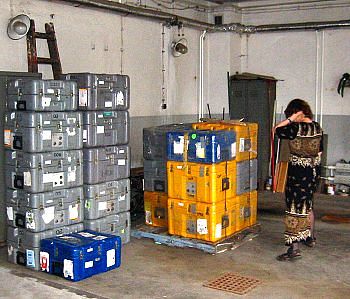
The equipment took about a week to arrive at the Geofyzikální Ústav (Geophysical Institute) in the city of Praha, Czech Republic. When the equipment got there the boxes for each country where grouped together so they would be ready to be picked up by people from the various educational and scientific institutions in each country. The pile on the left went to the field center in Poland, and the pile on the right was my equipment that was headed for Germany. All of the equipment arrived the day before I got there.
2018-03-06