


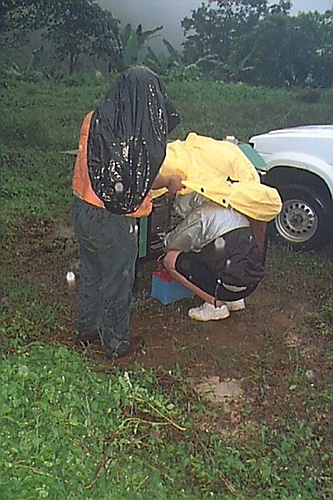
Installing the equipment was more fun than any person should be allowed. But the real excitement will be in maintaining this experiment over the six month lifespan. The relatively high sample rate of 200 samples per second per channel will generate over 200 megabytes of data per station per day. This data is recorded on the internal disk of the DAS. The disk drives in the DASs are only 1 gigabyte in size. This means that someone will have to visit each site and transfer the data on the internal hard drive to a portable hard drive once every 5 days at the most. A schedule was worked up where eight stations would be downloaded on Mondays and Thursdays, and the four relatively "hard" stations to get to would be downloaded on Tuesdays and Fridays. Assuming nothing goes wrong this schedule may work. None of this is quick, and rarely is it painless, especially if the weather turns ugly.
The two lucky guys tasked with keeping the array running during the six months are Al Portacio (on the left), and Zeus Zepeda.
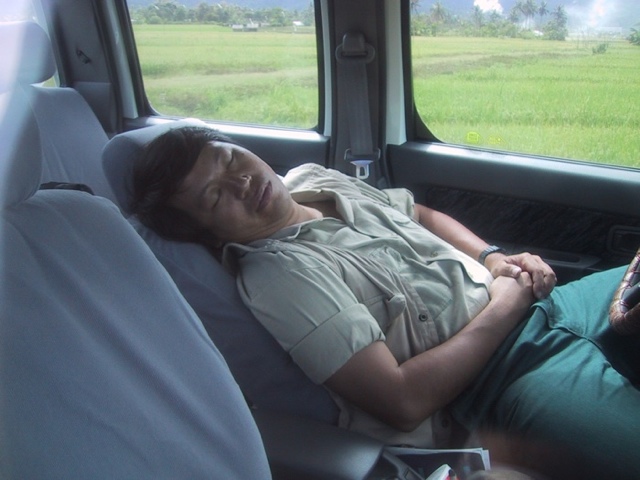
Al has worked for PGI for a couple of years. He is a geologist/geophysicist
that is in charge of keeping the Tiwi MEQ program running. He normally works
in the PGI office in Makati (Manila). Can you tell?? I just HAD to use this
picture. I just COULDN'T resist.  Actually, this was about the only time during the whole experiment I saw him
slow down!
Actually, this was about the only time during the whole experiment I saw him
slow down!
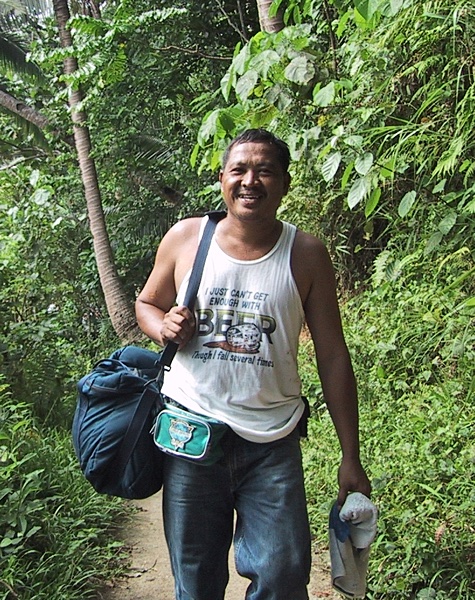
Zeus is a technician at the Tiwi facility. He has worked there for many years and lives in Tiwi.
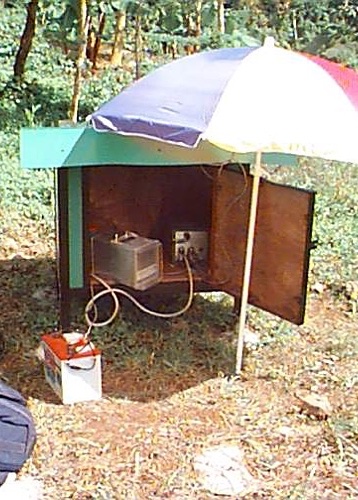
The equipment used for copying the data from the internal drive of the DAS is called the Fast Copy System (FCS). The FCS is the silver box in the photograph below. It was developed by PASSCAL and is a single board computer running Linux, and one program that knows how to copy data from one disk to another. The disk drives for the FCS are removable so when one fills up a replacement drive can be inserted and copying can continue.
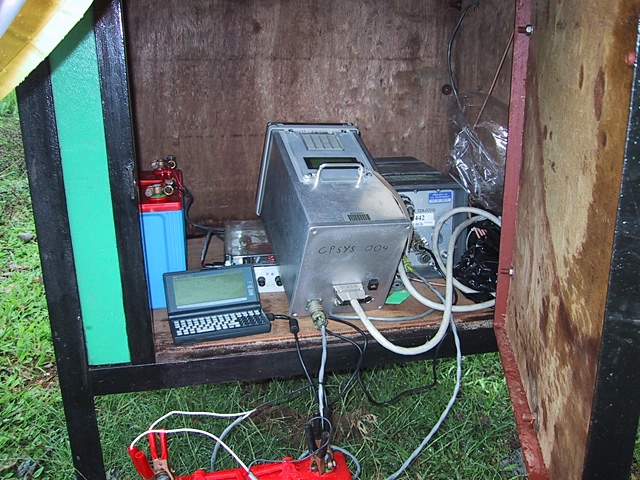
The system works pretty well as long as the weather isn't too wet or too hot.
Photos by Dody Astra
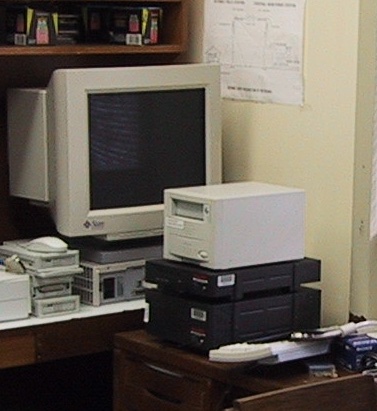
In addition to the field work there is also a lot of work to be performed back at the office. The data must be copied from the FSC portable disks to the Sun workstation. Once there it is massaged and analyzed to make sure the equipment at the stations is operating when you are not standing there next to them. They always wait until you leave have something go wrong. Once that's done the raw data is copied to tape and sent off for scientific analysis back at Lawrence Berkeley Laboratory in California. The Sun Microsystems computer "Topaz", an Ultra 1, was sent to Tiwi to handle the data processing. The disk drives from the FCS fit into that slot on the front of the white box. The tape drive is the thin black box, and the thick one is an external hard disk. The computer is under the large monitor, and three of the removable FCS disks are sitting to the left of the computer.
2018-03-03