
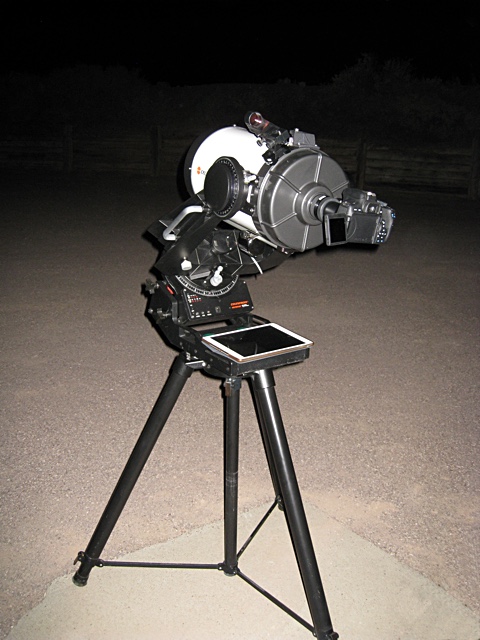
I rebuilt and collected a bunch of parts for the C8 known as Sedona last year,
but never really got around to using it much until this week. It made its
working debut one weekend at the monthly public star party put on at the local
college, and then the next weekend I was able to get it out for a calm looksie.
I put 10,000 step encoders on the Celestron Ultima mount and coupled them
with an AstroDevices Nexus II box. I can then use my iPad and SkySafari to
see where the scope is pointing, but something is a bit off with the combination.
It is very difficult to get the setup to align on more than two stars, and
with just two stars the pointing is not very accurate. It really could only
be that one or both of the encoders are slipping, but that doesn't seem likely.
SkySafari has always been hard to get aligned on more than two stars.
On the calm weekend after deciding the encoders/Nexus/SkySafari dance wasn't
going to go well I decided to slap my trusty Canon T6i on the back of the
scope and see what I could come up with in 30 seconds or less. These forked
and leaned over scopes are known to be pretty wiggly, and this one is one
of the known knowns. There's a lot of weight above the tripod and while it's
fine for just looking it's less fine for photography. 2000mm of lens is pretty
unforgiving when it comes to movment and tracking errors. However, in its
defense, it was a little breezy at times and the polar alignment was not stellar.
So it 'tis the season for looking at Omega Centauri without staying up way
past your bedtime, and that's what the scope was doing in the picture above.
OC is way down there. It only makes it up to about 7.5 degrees in Socorro.
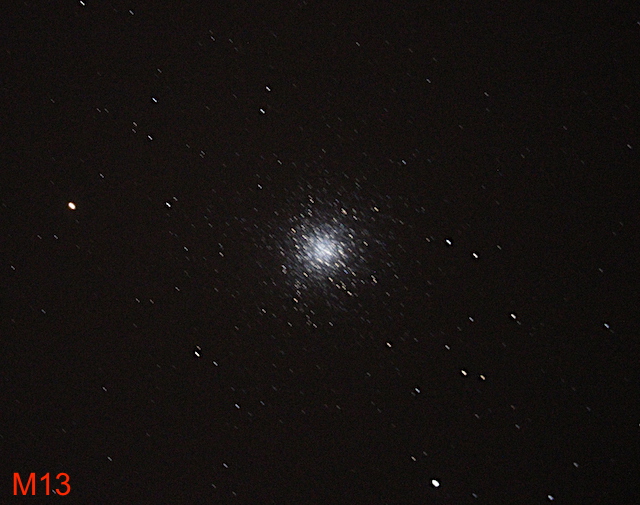
While I was at the observatory the perfessionals were using the big scopes to do some asteroid research. While making one of their trips between the telescope buldings they suggested, since I was taking pictures, a comparison of size of The Great Hercules Cluster, or M13, and Omega Centauri would fun. Sounded good to me. Above was a 20 second exposure of M13. See? Even 20 seconds was long enough to capture smeared stars with the focal length and bad polar alignment. It didn't help that every time I pressed the shutter release the breeze would pick up, or so it seemed.
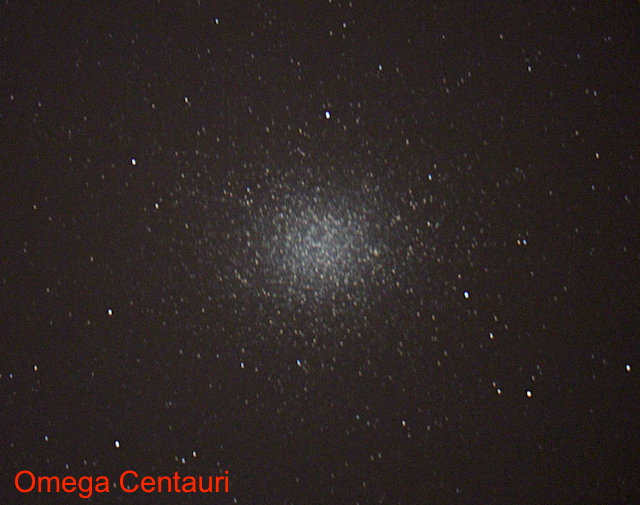
Hmmmm...this looks Greater. Both pictures are the same scale and exposure
settings of 20 seconds at ISO6400. I guess it helps that M13 is about 25,000
lightyears away and OC is about 16,000 lightyears, but the size difference
was a bit more than expected. The slightly orange cast in the OC picture is
light pollution. I took some of it out in post. There's also a lot of noise
in the pictures, because of the ISO6400 setting. Very cool.
The evening ended at about 0130. I'll need to figure out this encoder/pointing
problem, and it looks like the scope could use a bit of collimation adjustment.
While using the scope for outreach events is OK, a big fat Dobsonian, or anything
with a Go-To drive is better.
THE END
2018-06-10