


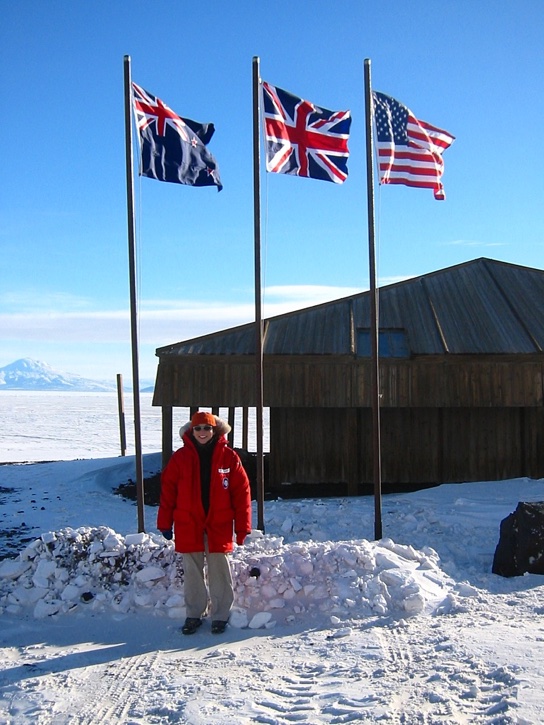
Above is Maggie Benoit of Penn State University in front of Discovery Hut in McMurdo at a ceremony that was commemorating the 100th anniversary of the beginning of Robert Falcon Scott's first expedition to the South Pole on November 2, 1902. After the ceremony the British flag was taken down, sent to South Pole Station, then returned to McMurdo to complete the journey that Scott was unable to finish. He failed to reach the South Pole on the attempt, but managed to go further south than anyone ever had and was able to gain valuable information on what it would take to reach and return from the South Pole which he failed to accomplish ten years later.
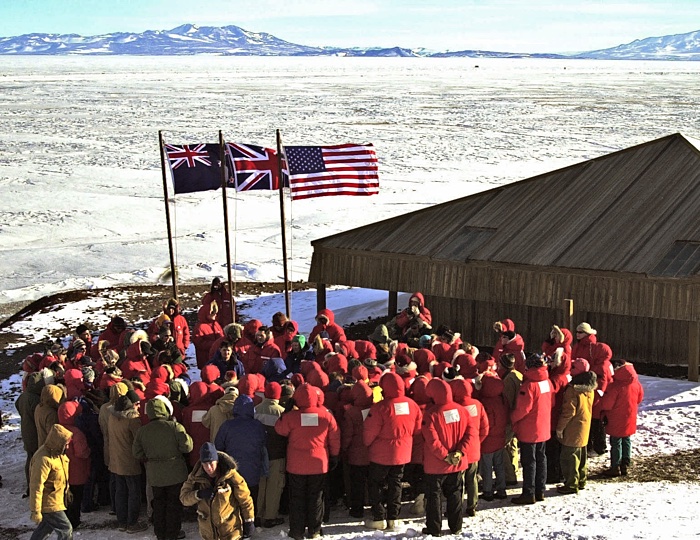
Photo by Melanie Conner of the The Antarctic Sun newspaper. I'm the one in the red coat.
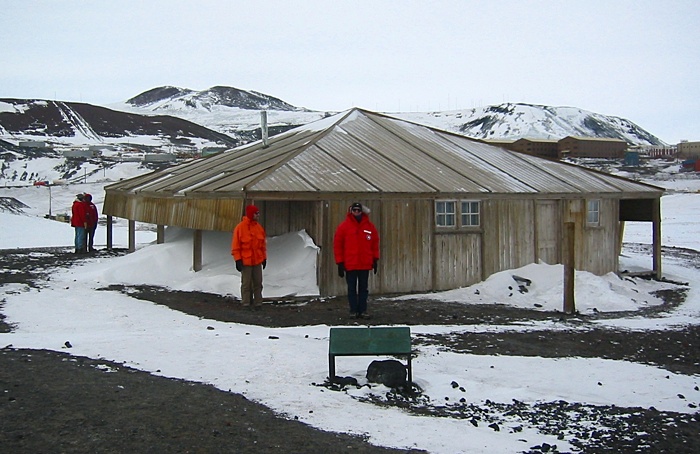
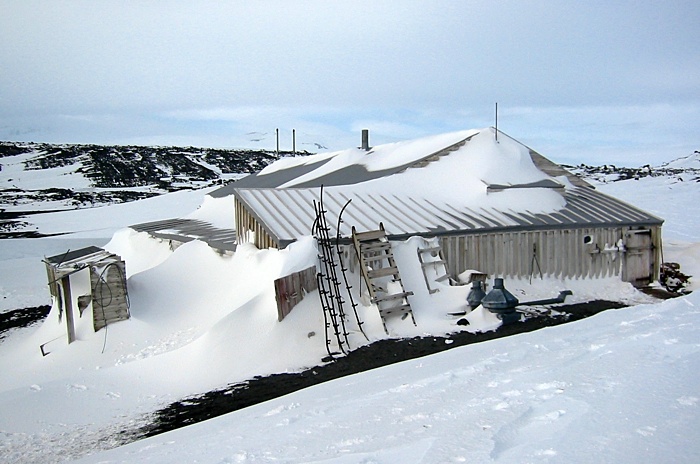
Above is a picture of Discovery Hut at McMurdo. The hut/base, which was named for Scott's ship, was built by Scott and his men in 1902. The hut was used quite a bit during Scott's second expedition in 1910-1912, and by others. Today it is in almost the same condition as it was when it was last used by the early explorers. The climate is very dry in Antarctica and anything that might rot in other parts of the world just becomes freeze-dried in Antarctica.
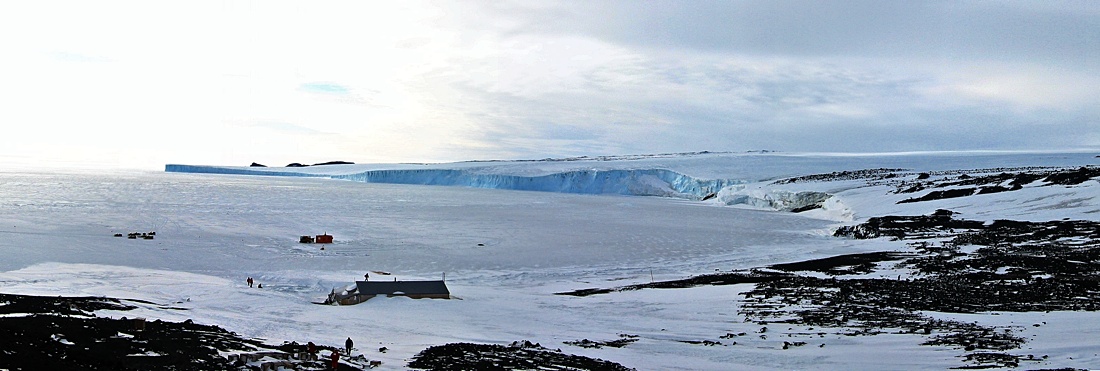
Above is North Bay, north of Cape Evans, taken from Wind Vane Hill. The cape was named for Scott's second in command, Teddy Evans. Barne glacier (see a few pictures below) is off in the distance with Cape Royds (see on the next page) over the horizon. Cape Evans is about 25 kilometers up the coast (North) of Ross Island from McMurdo.
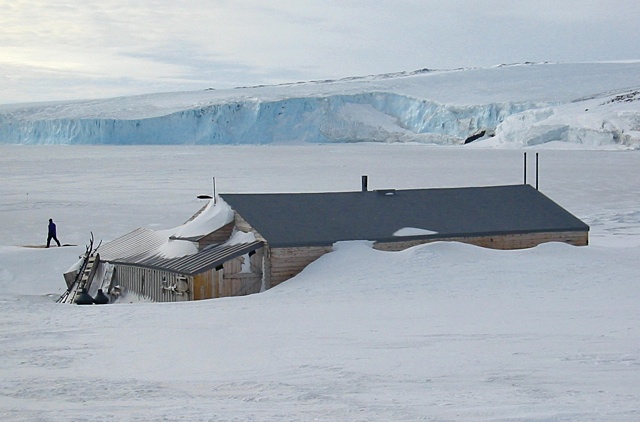
Above is a picture of hut Terra Nova built by Scott and his men at Cape Evans in 1911. Now why would Scott build a hut 25 kilometers up the coast in 1911 when he had a well established, plush estate at McMurdo? Because his ship, the Terra Nova, was unable to get all of the way down the coast of Ross Island and to the Discovery Hut on Hut Point Peninsula because of the sea ice conditions when he arrived. One of the goals of the 1910 expedition launched from this base was to make Scott and his team the first men to reach the South Pole. This expedition would be Scott's last attempt. He and Dr. E. A. "Bill" Wilson, Lt. H. R. "Birdie" Bowers, Capt. L. E. G. Oates, and Seaman Edgar Evans (not Lieutenant Evans which the cape was named for) reached the pole on January 17, 1912 only to find that Roald Amundsen of Norway had taken a more direct route than they had and had beaten them by 33 days. By the time they made it to the pole it was already getting to be late in the season for a return trip and the weather and ice conditions did not cooperate on their trip back. Evans died during their decent down Beardmore Glacier, probably from a concussion that he sustained in a fall. The glacier flows from the East Antarctic plateau to the Ross Ice Shelf through the Transantarctic Mountains. Oates, whose feet were badly frostbitten near the end, made the decision to leave camp during a storm to prevent slowing down the remaining three men. He was never seen again. Scott, Wilson, and Bowers died in their tent from the cold, lack of food and fuel, and their exhaustion on the Ross Ice Shelf. Their tent was found the next spring about 225 kilometers from McMurdo, and only 18 kilometers from the One Ton Depot for which they were heading. They were buried there in their tent of which no trace was found when Shackleton returned in 1916.
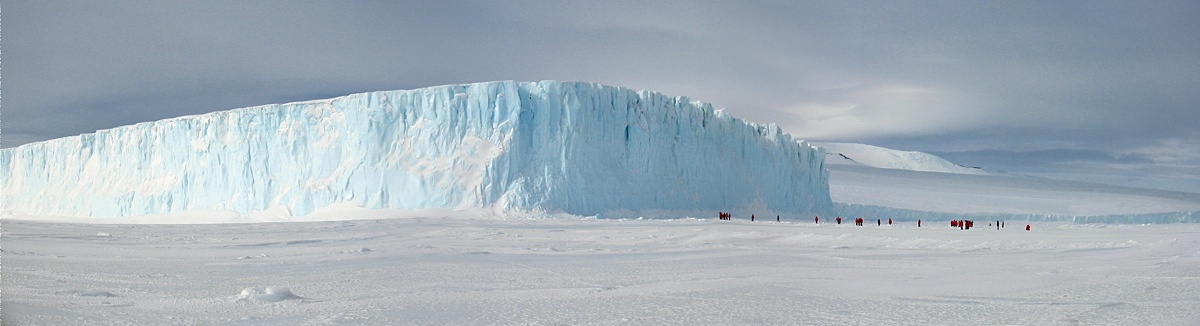
Above is Barne Glacier which is along the route to Cape Royds north of Cape Evans. This glacier is formed along the sides of Mt. Erebus and sticks out into the sound even after the sea ice has melted in late Summer, if the sea ice decides to melt at all.
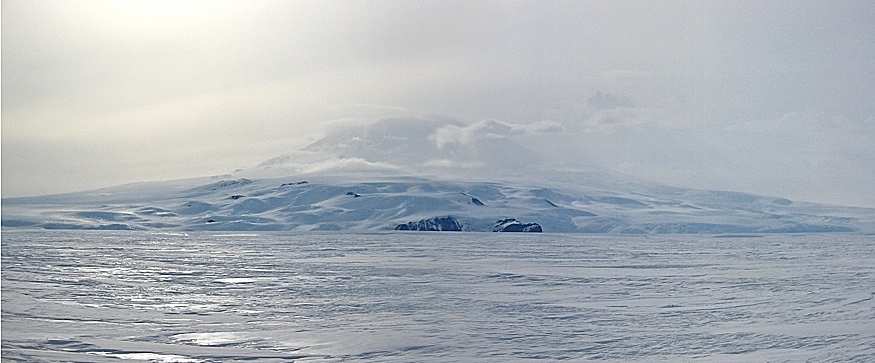
A ghostly Mt. Erebus from along our route near Cape Evans.
2018-03-05