


The next day. Now we could get some work done. The weather was like that.
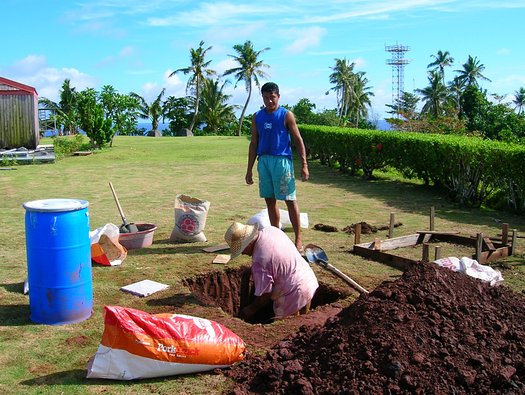
We got a fairly early start and began mixing cement. When it rains it is not
too nice. When it stops raining the place turns into a sauna and it is not
too nice. When the sky clears up and sun starts blazing it is not too nice,
but it IS pretty.

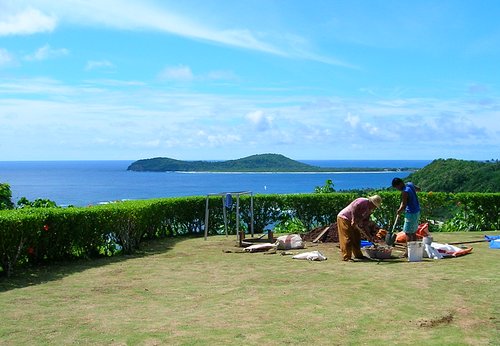
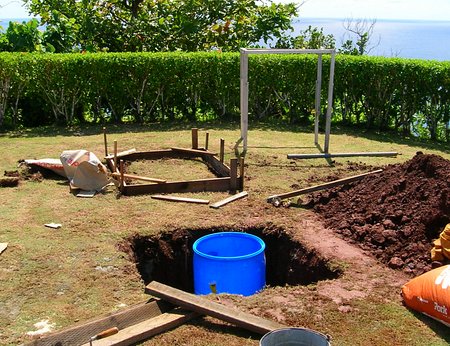
It took about ten of the tubs in the picture below of cement to get our job finished. I helped by poking at the wet cement with a stick after it was poured into the hole. It's the only kind of thing I'm qualified to do.
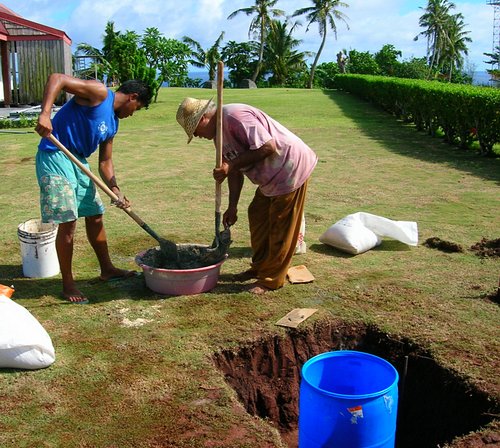
Voila! The cement work for our first station was finished. It took about two hours to finish up. The theory was that the barrel was sitting in a large chunk of cement, and it was also partially filled with cement all in the interest of stability and what is called coupling. A table with one short leg will wobble around if the floor shakes (like in an earthquake). It is not coupled to the floor very well. In order for the sensors to be at their best they need to be well coupled to the ground and shake along with the ground when there is an earthquake.
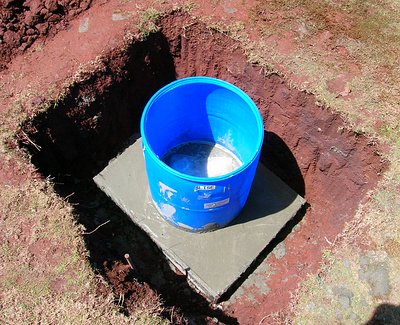
This was how we left the station. It took almost a week to get this first station to this point. The first one is always the most difficult. A couple of days before this Matt and Shaun went on to the island of Ta'u to get things moving there. With the technically difficult part of getting the barrel planting finished -- it had all been just a theory up to this point -- it was time for John and me to head for the island of Ta'u. There wasn't much left to do here but finish the cement for the pad, watch all of the cement dry and fill the hole back in around the barrel.
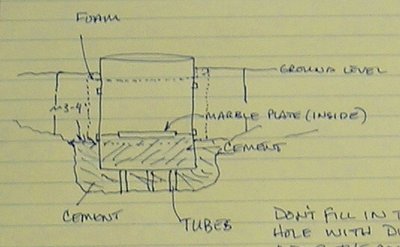
Just to give Mark an idea of where the construction was headed I left a drawing of the general game plan.
2014-08-03