


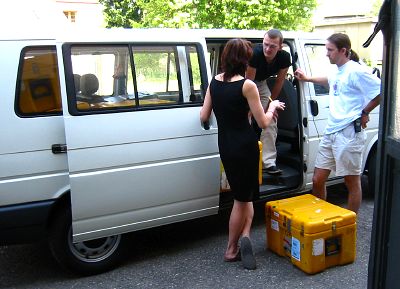
Before the start of the experiment the equipment was in Praha. That meant that people from Germany, Hungary, and Poland had to come to Praha to pick it up. Since the amount of equipment for each instrument center was not that large it was all handled by vans and small trucks. Below is one of the Principle Investigators (PI's) for the project, Pavla Hrubcova from Praha, going over with Alex Hemmann and Wolfram Geiss from Germany, the various strategies that would be required to get the equipment through the labyrinth of customs' rubber-stampers at the border. I traveled on the train from Praha to Jena a couple of days later.
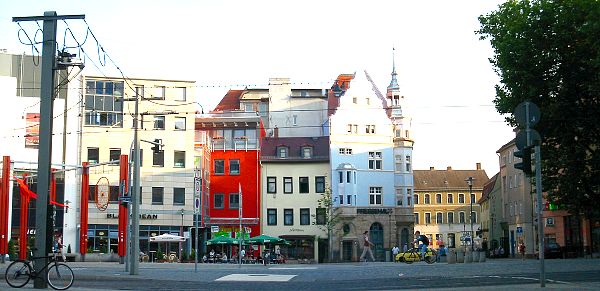
Jena is situated on the river Saale in the state of Thuringia Germany. The
town of Jani, which became Jena, was first mentioned around the year
830. Jena was first mentioned as a town in 1236. In 1523-1524, Jena became
one of the centers of the Reformation. Martin Luther visited Jena several
times and preached in the town church, which I failed to take a picture of.
The University of Jena (today named after Friedrich Schiller, a famous literary
figure of the late 1700's) was founded in 1558. The later famous glass industry
of Jena was introduced by Carl Zeiss in 1846. A large Carl Zeiss factory is
still located there. In 1942, near the end of World WarII, Jena was severely
damaged by several bombing raids. After the war large parts of the historic
town centre were left demolished until 1970. Below is a picture of the small
Holzmarkt Square in the central portion of Jena. The entrance to my hotel
is below the tree on the right.
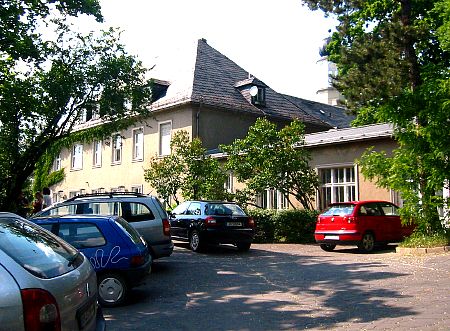
The Institut für Geowissenschatten (Institute for Geological Studies) college of the Friedrich Schiller University occupies a building that looks more like someone's house from the front than a research institution. Jena is somewhat unique in that its educational and manufacturing sectors were kept running during the 'East Germany era'. That meant that the standard of living around Jena was quite a bit higher than most of the rest of what was East Germany, therefore the town is in much better shape than other parts of Germany. There is quite a bit of high-tech research going on in the area.
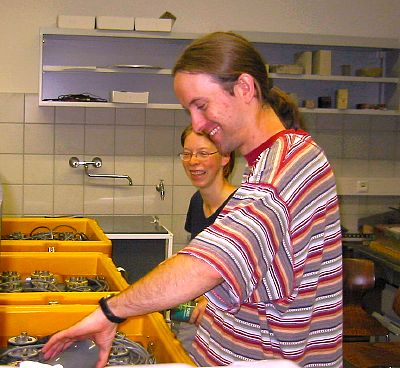
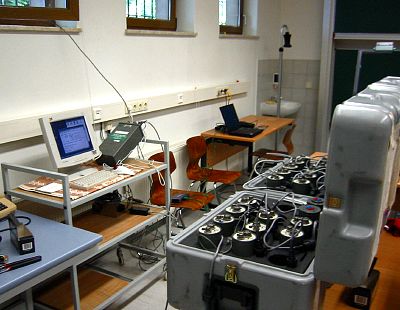
In the back section of the institute was a classroom (one of many), and Alex and Wolfram's office which we worked out of. Below is Wolfram and a student practicing the time honored tradition of putting the batteries into the Texans. Each Texan runs on two D-cell batteries. Wolfram looks pink because it is a lousy picture.
Since we only had 85 Texans to deal with (82 after everything was sorted out) we only needed to set up one bridge (the gray box next to the computer monitor) to program the Texans. The general plan was to program the Texans to record for several hours during many different time frames over a three day period. A total of about 29 hours of recording was to be done. Recording at a rate of 100 samples per second for 29 hours just about filled the 32 megabytes of memory that most of the units had.
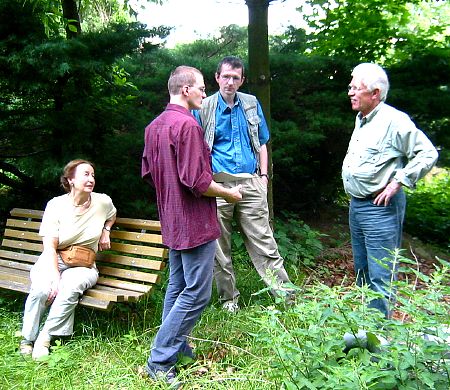
The gentleman on the right was our shooter (the guy that gets to set off the explosives) for some of the shots in Germany, Rudolf Brinkmann.
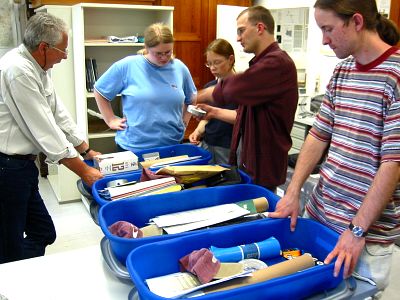
A little training was conducted for two of the deployment team members in the office. Wolfram did the training for the other teams when he delivered the Texans, the deployment books which each team used to keep track of which Texan was placed where, deployment location maps and instructions, and other paraphernalia. Alex really isn't as boring as Rudolf is making him out to be.
2018-03-06